Downlights are the least glamorous fixture in a lighting package and the one that generates the most after-sales cost. They are installed by the hundred, buried in a ceiling, and expected to work silently for a decade. When they fail, the replacement cost is trivial — the labour, access equipment and disrupted trading hours are not.
This guide is written from the buyer’s side of the table. It explains what a downlight actually is, which eight specifications decide whether a project succeeds, how to diagnose flicker instead of replacing fixtures at random, how to calculate fixture counts, and what to demand from a manufacturer before a purchase order is issued.
Contents
- 01What an LED downlight actually is
- 02Inside the fixture: where quality is decided
- 03The eight specifications that decide a project
- 04Fire-rated downlights: what the rating must cover
- 05Flicker: diagnose it, don’t replace blindly
- 06How many downlights does the project need?
- 07Compliance map for EU and North American buyers
- 08Sourcing: what to verify before the PO
- 09Applications and format selection
- 10The ten-point RFQ checklist
01What an LED downlight actually is
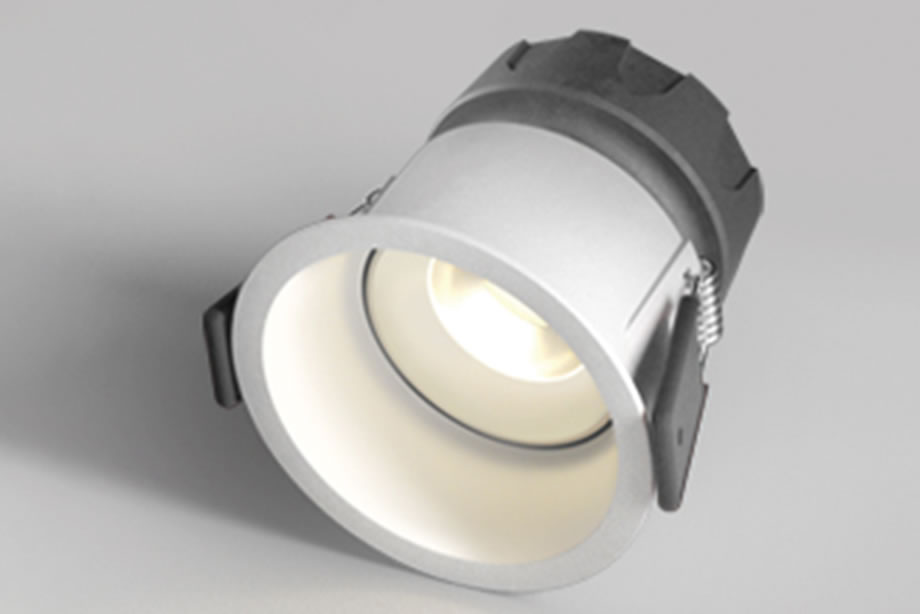
A downlight is a lighting fixture installed into or onto a ceiling. In North America it is commonly called a can light or pot light; in Europe and the UK, a recessed downlight or simply a downlight. The names differ by market; the physics do not.
There are three mounting methods, and the choice is usually dictated by the ceiling, not by preference:
- 1Recessed — set into a cut-out in the ceiling. This is the dominant choice because the fixture disappears: occupants see the light, not the lamp.
- 2Surface mounted — fixed directly to a solid ceiling where no void exists.
- 3Suspended — hung on a boom or chain, typically in retail and industrial spaces with high ceilings.
Downlights range from 2.5″ to 10″ in diameter. The working sizes are 3″, 4″, 6″ and 8″ — 4″ and 6″ cover the majority of residential and hospitality specifications.
Because the source is compact, the beam is directional. That is the defining characteristic of a downlight and the source of most specification errors. Narrow beams create accents and wall-washing; wide beams deliver general illumination without dark corners. The same fixture family can do both, but only if the beam angle is specified rather than assumed.
02Inside the fixture: where quality is decided
A traditional downlight was a housing plus a replaceable lamp — incandescent, halogen or compact fluorescent. Those sources consumed far more energy than they delivered and have been almost entirely displaced by LED. In an integrated LED downlight, source, driver and optics are engineered as one unit, which removes the protruding-lamp problem that plagued retrofit housings.
Four components determine how the product behaves over its service life:
- Heat sink. Normally ADC12 die-cast aluminium or a high-strength aluminium alloy. Thermal performance here governs lumen depreciation and LED lifespan more than any other single factor.
- Driver. Converts mains AC to the DC the LED requires. It is the component most likely to fail first, and the one buyers should scrutinise most closely.
- Optics. A diffuser produces soft, even light; a lens concentrates output for accent and display work.
- Retention and trim. Spring clips on both sides hold the fixture in the ceiling; the trim ring carries the finish and, where required, the fire-rated intumescent material.
The LED itself is a solid-state semiconductor device: current drives it to convert electrical energy directly into light. Because LEDs cannot run on mains voltage, the driver steps AC down and rectifies it to DC. Household supply is either AC 100–140 V (North America, Japan) or AC 220–240 V (Europe, most of the rest of the world) — a distinction that must be settled before the order, not after.
03The eight specifications that decide a project
Most downlight disputes trace back to one of eight numbers that were never written into the purchase order. Each has a defensible answer depending on the application — the failure mode is silence, not a wrong choice.
Scroll the table horizontally to view all columns →
| Specification | Why it matters | What to put in the RFQ |
|---|---|---|
| Luminous efficacy | Determines fixture count and running cost. A 15 % efficacy gap across several hundred fixtures is a visible electricity line item. | State a minimum lm/W. Recessed ranges typically reach 100 lm/W and above; surface-mounted formats are offered at 90 or 120 lm/W; IP65 SMD bathroom formats sit at 85–90 lm/W. |
| Colour rendering (CRI / Ra) | Governs how merchandise, skin tones and finishes read. Low CRI makes premium materials look cheap under artificial light. | Ra80 for general commercial and residential; Ra90 for retail, hospitality and displays; above 95 for museums and critical colour work. |
| Colour temperature | Sets the atmosphere of the space and must match adjacent fixtures on the same circuit. | 2700 K / 3000 K / 4000 K / 5500 K, plus 3-CCT or 5-CCT selectable versions where one SKU must serve several rooms. |
| Beam angle | The difference between an accent scheme and general lighting. Wrong angle produces scallops on walls or dark floors. | Narrow 10° / 24° / 36° for accent and adjustable formats; 60–90° for COB bathroom; 120° for SMD; 24° / 38° for surface-mounted. |
| Dimming protocol | Protocol mismatch is the single most common cause of incompatible dimming on site. | Name the system: SCR (leading/trailing edge), 0–10 V (1–10 V) or DALI. Never accept “dimmable” as a specification. |
| Ingress protection | Bathrooms, shower zones and exterior soffits need sealing that general commercial spaces do not. | IP44 for general commercial and retail; IP65 for bathrooms, wet zones and outdoor covered areas. |
| Fire rating | A building-regulation requirement in many ceiling assemblies, not an optional upgrade. | 30 / 60 / 90 minutes — matched to ceiling thickness and joist spacing on the project drawings. |
| Profile and adjustability | Shallow voids restrict what can be installed; fixed heads cannot correct a lighting design after the ceiling closes. | 11 mm slim profiles for shallow voids; 20° tilt for adjustable formats aimed at walls or displays. |
3-CCT and 5-CCT fixtures are usually switched in one of two ways: by toggling the wall switch in sequence, or by a DIP switch on the junction box. The first lets an installer change colour without removing the fixture; the second fixes the colour at commissioning. Both are legitimate — but they are not interchangeable in a specification, and the buyer should state which is required.
04Fire-rated downlights: what the rating must cover
A fire-rated downlight is designed to resist the passage of fire through a ceiling assembly. The mechanism is intumescent material that expands under heat and closes the aperture created by the cut-out. In a fire, that delay buys occupants time to evacuate and responders time to act.
Fire ratings are expressed as 30, 60 or 90 minutes, matched to the ceiling specification — thickness and joist spacing vary between assemblies, and the rating must correspond to the assembly actually being built.
The meaningful distinction between suppliers is not the headline rating but where the intumescent material sits. A fixture that carries fire-rated material at every joint of the heat sink closes the assembly as a unit. A fixture carrying only a single layer does not achieve the same result, however similar the datasheet looks. When comparing quotations, ask for the test report and confirm the construction, not just the number.
Fire-rated formats are commonly offered with dimmable drivers, in bezel finishes of white, satin nickel and chrome, and in the standard colour temperatures of 2700 K, 3000 K, 4000 K and 5500 K — so compliance need not force a compromise on the interior scheme.
05Flicker: diagnose it, don’t replace blindly
Visible flicker means part of the fixture has failed. There are exactly two candidate causes, and they can be separated in the field with one swap.
- 1The LED driver has failed. This is the majority of cases.
- 2The LED chip has failed.
The field test: substitute a known-good, non-flickering driver. If the flicker stops, the driver is the fault. If it persists, the chip is.
If the chip is at fault, the usual mechanism is a loosened bonding wire, caused by excessive temperature. That in turn points to one of two root causes — insufficient heat-sink capacity or excessive driver output current. Both should be measured before the fixture is replaced, otherwise the replacement will fail the same way. Age beyond rated life is a third, legitimate explanation.
Driver failures typically originate in the freewheel diode or in the power-supply capacitors. These are not field-repairable; the driver is replaced as a unit. This is precisely why driver brand and thermal design deserve more attention during sourcing than the LED chip brand that appears on the marketing sheet.
Flicker is a symptom. The specification error that caused it is upstream — in the heat sink, the driver, or the current setting.
06How many downlights does the project need?
Fixture count is arithmetic, not instinct. Three inputs drive it: the area and height of the space, the wattage and lumen output of the chosen fixture, and the illuminance the application requires.
Lux = (Total Lumen × 0.5) / Area (m²)
Working formula for preliminary downlight planningWorked example. A retail space of 100 m² with a 3 m ceiling. The specification calls for 15 W fixtures delivering 1,350 lm, and the target illuminance for retail is 300–500 lux — take the mid-point, 400 lux.
Scroll the table horizontally to view all columns →
| Input | Value | Note |
|---|---|---|
| Target illuminance | 400 lux | Mid-point of the 300–500 lux retail band |
| Fixture output | 1,350 lm | 15 W fixture |
| Area | 100 m² | Height 3 m |
| Utilisation factor | 0.5 | Built into the formula |
| Result | ≈ 60 fixtures | 400 = (1,350 × n × 0.5) / 100 → n ≈ 59.3 |
Two caveats belong in any tender document. First, this is a planning estimate: ceiling reflectance, furniture layout and mounting height all move the final number, and a lighting design should confirm it. Second, an IP44 fixture is adequate for a mall interior — do not pay for IP65 across an entire project because one wet area required it.
07Compliance map for EU and North American buyers
Certification is a market-access question before it is a quality question. A fixture without the relevant mark cannot be lawfully placed on the market, insured, or accepted by a specifying engineer — regardless of how well it performs.
Scroll the table horizontally to view all columns →
| Market | Marks to request | What they cover |
|---|---|---|
| North America | UL, ETL | Safety certification for the US and Canadian market; commonly required by distributors, specifiers and inspectors. |
| European Union | CE, CB | CE marking for placement on the EU market; CB reports support conversion to national schemes. |
| Australia / NZ | SAA | Electrical safety compliance for the Australian market. |
| All markets | RoHS | Restriction of hazardous substances — a documentary requirement in most Western procurement processes. |
| Factory level | ISO 9001 | Quality management system certification; evidence that process control exists beyond the sample. |
Request the certificates against the exact model being quoted. A certificate for a similar family is not a certificate for the SKU in the purchase order, and this is one of the most common findings in pre-shipment audits.
08Sourcing: what to verify before the PO
Downlights are a mature product. The difference between a good and a poor supplier is rarely the catalogue — it is whether the factory can hold a specification across repeat orders.
LIISEE LIGHTING has manufactured LED lighting in Shenzhen since 2008, with more than a decade of dedicated downlight production. The operation runs a 5,000 m² production workshop and a 1,000 m² warehouse, staffed by 78 production workers, 10 quality-control inspectors and 5 engineers. Capacity is above 120,000 downlights per month, which matters when a retail rollout lands on a fixed opening date.
Bill of materials is where a quotation is won or lost. Higher-end builds specify Osram or Philips LED chips and Lifud or Philips drivers; the driver choice in particular determines dimming compatibility and field failure rates. Warranty runs from 2 to 5 years depending on series, and the factory operates an ISO 9001 quality management system with UL, CE, RoHS, CB, SAA and ETL certification across the range.
For buyers developing a private label, the relevant capability is one-stop OEM: housing and trim tooling, driver selection, optics, packaging and labelling handled against a single specification. This is the point at which a supplier becomes a manufacturing partner rather than a source of stock.
09Applications and format selection
Format follows function. The matrix below reflects where each downlight type earns its place.
Scroll the table horizontally to view all columns →
| Format | Typical application | Specification note |
|---|---|---|
| Slim recessed (11 mm) | Residential, hospitality, shallow ceiling voids | 4″ and 6″; 3-CCT or 5-CCT; junction box; dimmable |
| Standard recessed | Offices, hotels, schools, hospitals, exhibition halls | 100 lm/W and above; Ra80 or Ra90; anti-glare; flicker-free driver |
| IP65 bathroom | Bathrooms, shower zones, covered outdoor areas | 10–24 W; COB at 60–90° or SMD at 120° |
| Fire-rated | Ceilings in regulated building assemblies | 30/60/90 min; dimmable option; three bezel finishes |
| Adjustable | Retail, galleries, showcases, clothing stores | ±20° tilt; 10°/24°/36° beams; up to 100 lm/W |
| Surface mounted | Solid ceilings without void | 24° or 38°; 90 or 120 lm/W; IP65 version for outdoor |
Two principles resolve most selection debates. In spaces where the ceiling is a design feature, recessed and slim formats preserve the plane. In spaces where merchandise or architecture must be emphasised, adjustable narrow-beam formats do the work that general lighting cannot.
10The ten-point RFQ checklist
Send this with the enquiry. A supplier who cannot answer all ten in writing is not ready for a project order.
- 1Efficacy in lm/W, measured at the quoted wattage — not a family average.
- 2CRI (Ra) and the R9 value where colour-critical applications are involved.
- 3Colour temperature, and whether the CCT-selectable mechanism is switch-sequence or DIP switch.
- 4Beam angle, with the optic type identified.
- 5Dimming protocol and the specific driver model offered.
- 6IP rating, and the test report supporting it.
- 7Fire rating in minutes, with the test report and a description of the intumescent construction.
- 8Certificates (UL / ETL / CE / CB / SAA / RoHS) issued against the exact model quoted.
- 9Rated life, warranty terms, and the lumen maintenance figure at end of warranty.
- 10MOQ, production lead time, and monthly capacity for the forecast volume.
The cheapest fixture is rarely the cheapest project. Price the replacement labour and access equipment for one failure per hundred units, add the electricity delta from a lower efficacy, and the ranking usually changes. Buyers who specify properly once tend to specify the same way on the next order.
Specifying a downlight package?
Send drawings, target illuminance and market requirements. Our engineering team returns a fixture schedule, a compliance pack and a quotation against a single specification.