LED Downlights for Commercial, Residential and Project Lighting
LIISEE designs and manufactures recessed, surface-mounted and fire-rated LED downlights in Changzhou, China. Fifteen years of OEM production for lighting brands across more than 60 export markets, with documented photometrics and lead times a programme can be planned around.
Overview
What an LED downlight is, and where it is specified
A downlight is a ceiling luminaire that throws light downward from a small aperture. Most of what matters in a specification is decided before the fixture is chosen: mounting method, aperture size, beam angle and how the heat leaves the body.
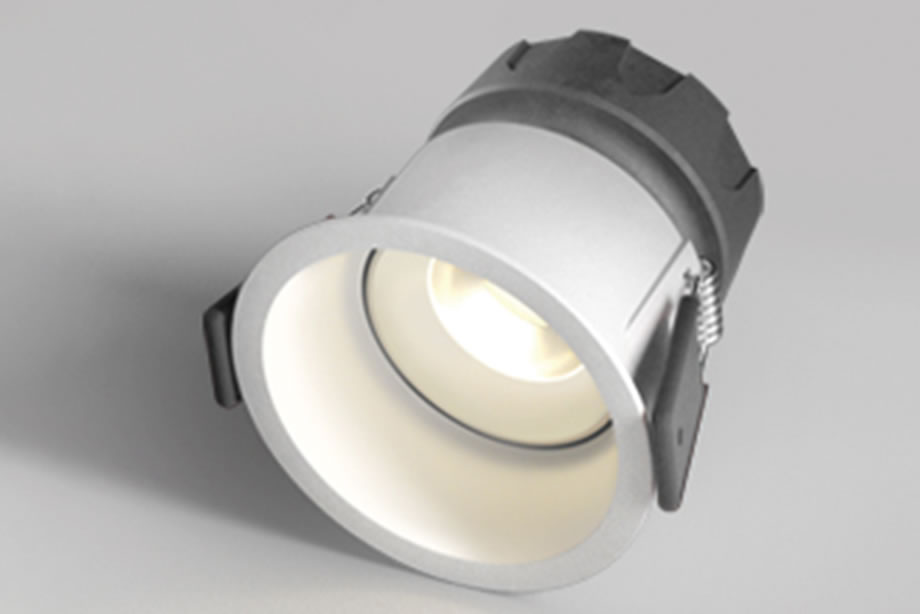
In a recessed downlight the body sits above the ceiling line and only the trim ring is visible, so the ceiling reads as architecture rather than as a row of fittings. Surface-mounted and suspended versions exist for ceilings without a void, or for halls where light has to be brought down to working height.
Traditional downlights paired a replaceable halogen or compact fluorescent lamp with a separate fitting, and the lamp often protruded below the trim. An integrated LED downlight combines the light engine, optic and driver in one body. That removes the protrusion, allows an 11 mm profile on slim panels, and raises efficacy and service life at the same time.
Recessed
Set into a ceiling cut-out, flush with the plasterboard. The default choice wherever a ceiling void exists, and the cleanest result for new-build and refurbishment.
Surface mounted
Fixed directly to the ceiling where there is no void: concrete soffits, retrofit work, service corridors.
Suspended
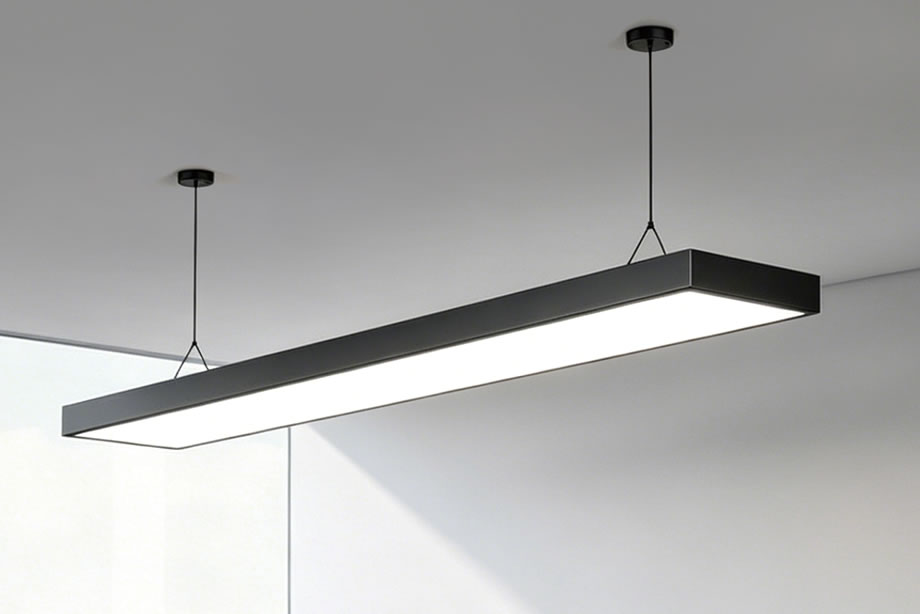
Hung on a boom or chain for high ceilings and industrial halls, bringing the light source down to a usable mounting height.
Apertures run from 2.5″ to 10″, and 3″, 4″, 6″ and 8″ cover most projects. Beam angle then decides the effect: narrow optics of 10° to 24° produce accent and wall-washing, while 60° to 120° distributions give general illumination without dark patches between fittings.
Product Range
Three families that cover most downlight specifications
Each family is built around a different constraint: ceiling depth, glare control, or fire and water protection. Everything below is standard production, not a sample programme.
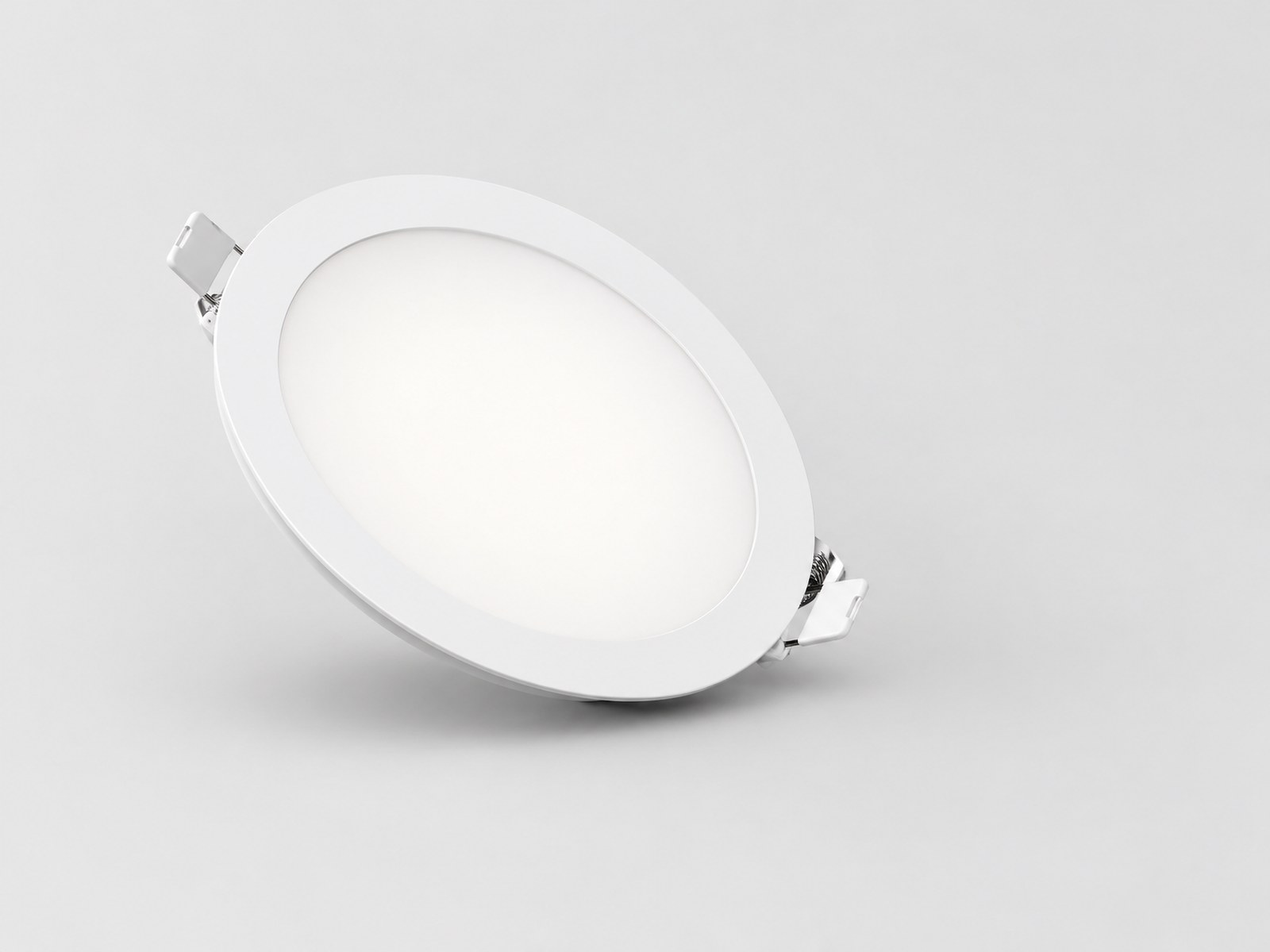
Slim Recessed Downlight
An 11 mm body for shallow voids and retrofit work. Integrated junction box, 3CCT or 5CCT selectable at the box, TRIAC dimmable, round or square trim.
11 mm body3CCT / 5CCTTRIAC dimmingRound or square trim
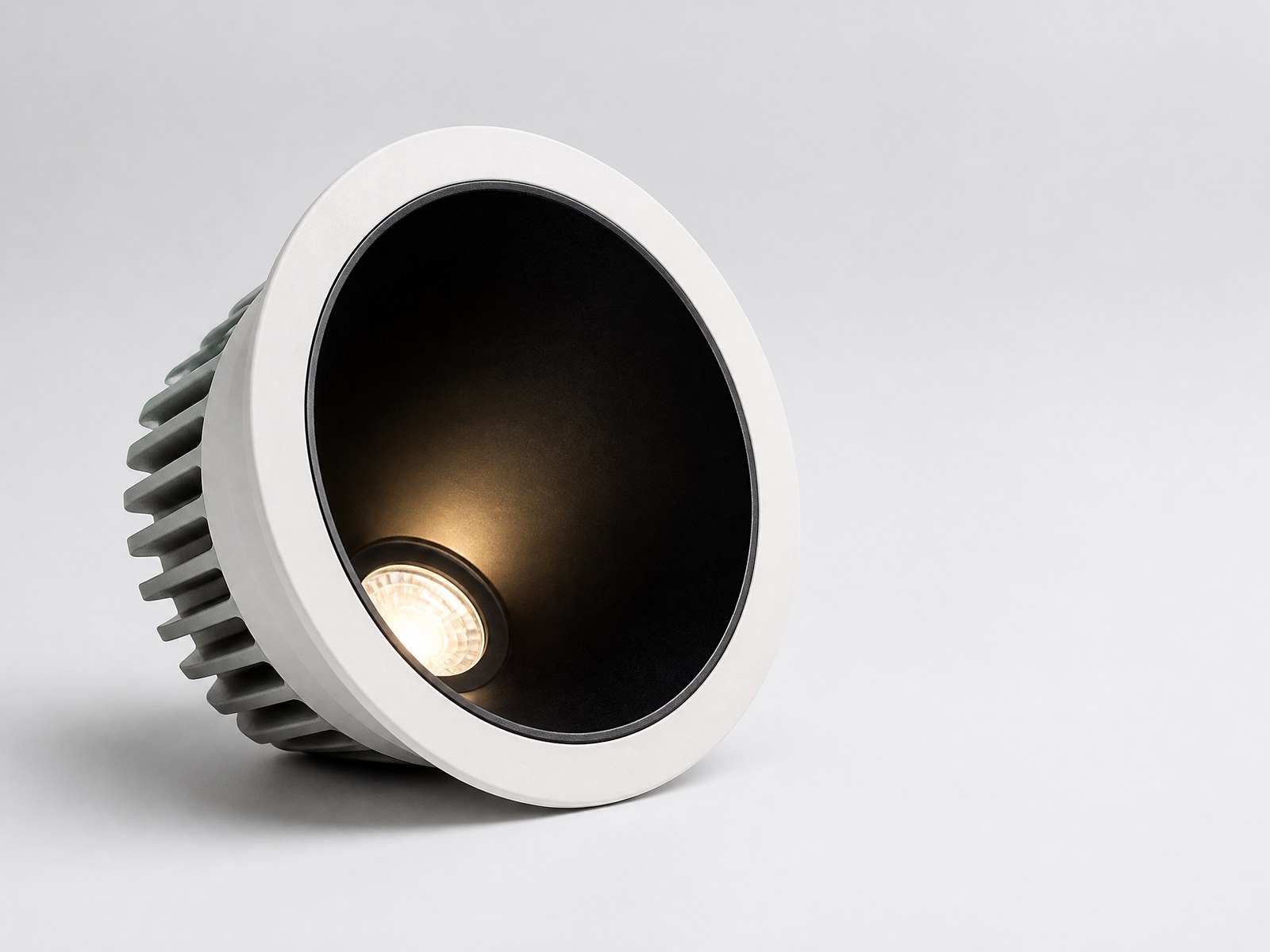
COB Anti-Glare Downlight
A deep black baffle keeps the source out of sight and holds UGR below 19, the figure that decides whether a client signs off the ceiling. Ra90 as standard.
UGR < 19Ra90 standardDeep black baffle
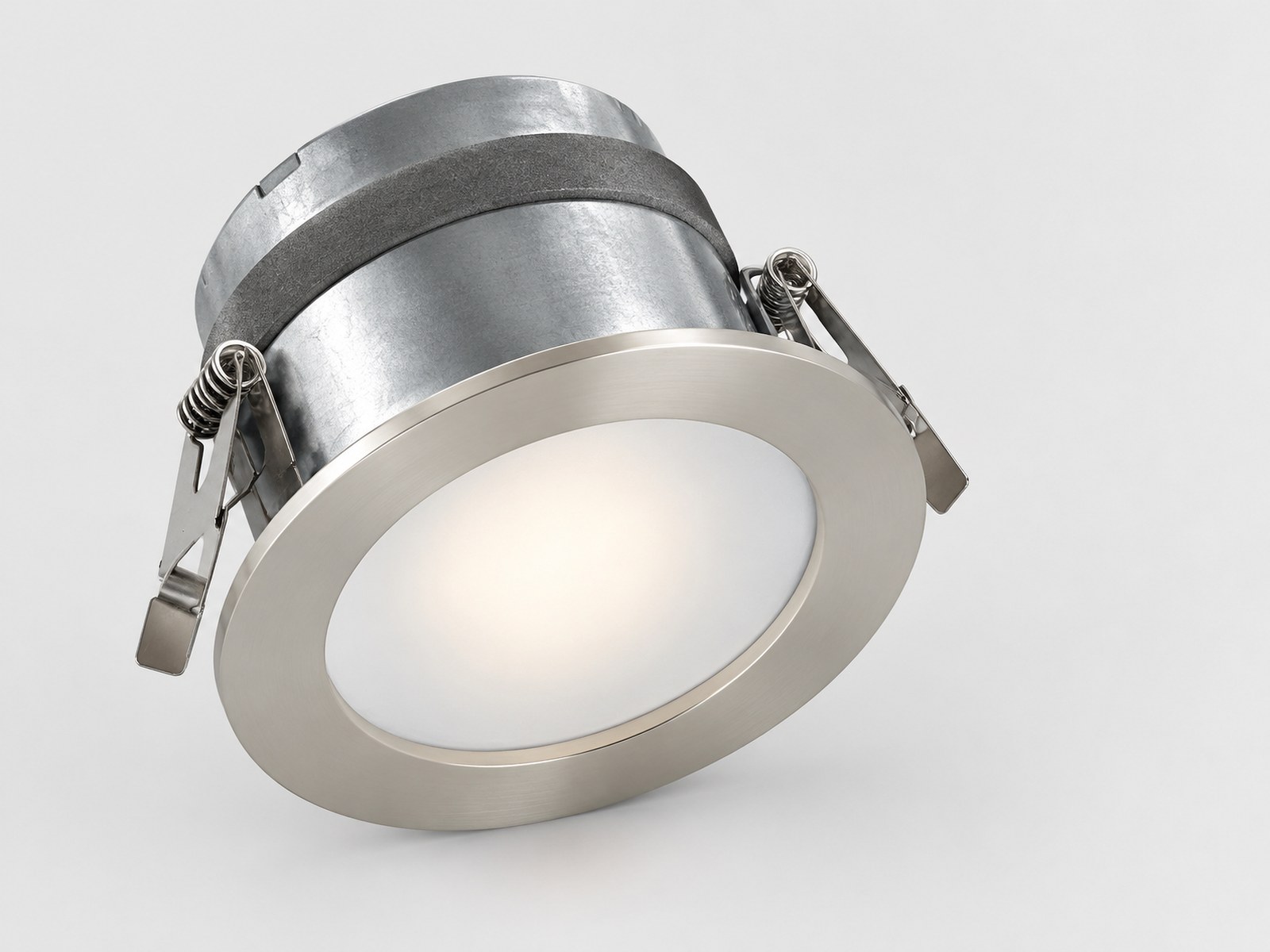
Fire-Rated and IP65 Downlight
Intumescent collar tested to 30, 60 and 90 minutes, sealed IP65 lens and satin nickel, white or chrome trim for bathrooms, corridors and escape routes.
30 / 60 / 90 minIP65 sealedIntumescent collar
Model Range
Seven families, one production line
What we build most often. Custom optics, wattages, cut-outs and trims are part of normal OEM/ODM work here, not a special request.
| Family | Mounting | Cut-out / size | Power | Typical specification |
|---|---|---|---|---|
| Slim recessed panel | Recessed | Ø 120 / Ø 170 mm (4″ / 6″) | 9–18 W | Retrofit, apartments, corridors |
| COB anti-glare | Recessed | Ø 75–150 mm | 10–30 W | Hotels, retail, feature ceilings |
| Fixed recessed SMD | Recessed | Ø 90–200 mm | 10–30 W | General commercial and office |
| Adjustable / tilt | Recessed | Ø 75–160 mm | 6–30 W | Accent, displays, wall washing |
| Square recessed | Recessed | 90–225 mm | 10–60 W | Grid ceilings, offices |
| Fire-rated | Recessed | Ø 70–90 mm | 8–12 W | Residential, escape routes |
| IP65 bathroom | Recessed | Ø 85–110 mm | 10–24 W | Bathrooms, wet areas |
| Surface mounted | Surface | Ø 90–160 mm | 9–45 W | No ceiling void, retrofit |
Manufacturing
Heat and driver quality decide whether a downlight lasts. Both are built in-house.
A downlight fails in one of two ways: the LED junction overheats, or the driver dies. We control both inside a 7,000 m² facility in Changzhou, with housing fabrication, SMT, assembly, aging and photometric testing under one roof.
Housing and thermal path
ADC12 die-cast aluminium bodies, cut and punched in-house, so the thermal path from board to ambient stays consistent batch to batch.
SMT and PCB assembly
Automated SMT lines with thermal-profile control. The light engine and the fixture are made in the same building, not bought in and assembled.
100% aging, not sampling
Every fixture runs a burn-in before packing, so drivers and chips are proven before they leave rather than after they fail on site.
Photometric verification
An integrating sphere and IES equipment confirm lumen output, CRI and CCT against the specification. Reports are issued with quotations when a tender needs them.
Configuration
Configurable options
The configurations below are standard. Anything outside them can usually be built, so send the requirement and we will confirm tooling, MOQ and lead time.
| Parameter | Options |
|---|---|
| Power | 3–60 W, single or dual wattage selectable |
| Luminous efficacy | 85–120 lm/W, model dependent |
| Colour temperature | 2700 / 3000 / 3500 / 4000 / 5000 / 5700 K; 3CCT and 5CCT switchable |
| Colour rendering | Ra80 standard; Ra90 and Ra95 available |
| Beam angle | 15° / 24° / 36° / 60° / 90° / 120° |
| Dimming | Non-dim, TRIAC, 0-10 V, DALI |
| Ingress protection | IP20, IP44, IP65 |
| Fire rating | 30 / 60 / 90 minutes on the fire-rated family |
| Trim finish | White, black, satin nickel, chrome |
| Cut-out | Ø 68–225 mm |
| Controls | Microwave or PIR sensor, Wi-Fi, Bluetooth |
| Operating temperature | -20 °C to +45 °C |
Applications
Where these downlights are specified
The same body is configured differently by application. The two variables that change most are beam angle and colour rendering.
Hotels and hospitality
COB anti-glare at 24° for lobbies and corridors, UGR below 19 so guests are not looking into the source. Warm 2700–3000 K throughout.
Offices and workplace
Fixed or square recessed at 4000 K with wide distributions for even desktop illuminance; 0-10 V or DALI where the lighting is controlled.
Retail and supermarket
High efficacy fixed downlights for ambient light, narrower optics for displays and wall washing. 3500–4000 K keeps merchandise colours neutral.
Residential
Slim recessed for shallow voids, fire-rated over habitable rooms where building regulations require a protected ceiling.
Healthcare and education
Flicker-free drivers and Ra90 output for examination and reading tasks; IP65 versions for wet rooms and clinical wash-down areas.
Museums and exhibition
Ra95 and tight beam control where colour accuracy is the point. Adjustable bodies allow the aim to be changed after the fit-out.
Sizing Guide
How many downlights does the ceiling need?
Downlight counts are set by the illuminance target, not by habit. The lumen method gives a reliable first number before a full DIALux study.
Worked example: a 100 m² retail floor with a 3 m ceiling, a 400 lux target, and a 15 W downlight delivering 1,350 lm. Taking CU × MF as 0.5 for a typical retail ceiling:
Treat the result as a starting point. Spacing, ceiling height, reflectance and the merchandise layout all move the final figure, which is why we run the layout before the order is fixed.
- Recessed fittings need a void depth that clears the driver and the spring clips.
- Fire-rated models need a cut-out that matches the intumescent collar, not the trim.
- On 24° optics, spacing beyond 1.5 times the mounting height starts to leave dark bands.
Send the floor plan and the lux target and our engineers return a layout with photometric files. Dialux simulation is free of charge.
Compliance
Documentation that survives a tender review
A buyer or a consultant will ask for the same four things. We keep them current and send them with the quotation.
ISO 9001
Certified quality management system across incoming inspection, production and final test.
CE and RoHS
Declarations of conformity and RoHS test reports issued per model for European projects.
amfori BSCI
Social compliance audit covering working hours, wages, safety and subcontractor control.
National High-Tech Enterprise
Awarded in 2016 for sustained investment in LED lighting research and engineering.
FAQ
Questions buyers ask before the first order
What is an LED downlight?
A ceiling fixture that directs light downward through a small aperture, with the LED light engine, optic and driver integrated in one body. Compared with a traditional downlight it uses less energy, lasts far longer, renders colour better and can be built only 11 mm thick, because there is no replaceable lamp to accommodate.
What makes a downlight fire-rated?
Fire-rated models carry an intumescent material around the housing. In a fire it expands and closes the ceiling aperture, so the ceiling keeps acting as a fire barrier for the rated period of 30, 60 or 90 minutes. The rating is proven by test, not by the presence of a metal can, and the collar must match the cut-out drilled on site.
Why do LED downlights flicker?
Almost always the driver, occasionally the LED board. Swap the fixture onto a known-good driver: if the flicker stops, the driver is the cause; if it continues, the board is. Board failures usually come from sustained over-temperature, which points at an undersized heat sink or a driver pushing too much current. Visible flicker is a fault, not a dimming feature.
How does an LED downlight work?
The driver converts mains AC into a regulated DC current. That current drives LEDs mounted on an aluminium substrate, which is pressed against a die-cast body that carries the heat to the ambient air. Optical control comes from a reflector, a lens or a diffuser in front of the board. Efficacy, life and colour consistency all depend on that thermal chain staying intact.
How many downlights do I need?
Start from the lux target and the lumens per fitting, then divide by the area, allowing for utilisation and maintenance. The worked example above returns 60 fittings for a 100 m² retail floor at 400 lux. Send us the plan and we will run the layout with photometric files rather than leave it to a rule of thumb.
Get a Quote
Send the ceiling plan before you commit to a wattage
Tell us the application, ceiling height, cut-out and the certification your project requires. We will confirm the family, the wattage and the trim, then return a quotation with lead time and the test documents that go with it.