how-you-match-cri-to-the-application
As a lighting engineer, you have probably stood on a finished site and heard it: “The light level is fine, but the meat looks brown, skin looks pale, and the wood has lost all its warmth.” Your lux meter agrees with your calculation, and your client still is not happy.
Direct answer
CRI measures how accurately a light source reproduces colors compared to natural light. For most professional LED projects, specify CRI 90 or higher, check R9 separately for deep-red rendering, and confirm SDCM (ideally 3 steps or less) for batch-to-batch consistency. When both color accuracy and saturation matter, add TM-30 (Rf / Rg) to your spec.
01Why Your Fixtures Hit the Lux Target but Still Get Rejected
As a lighting engineer, you already know what is happening. The problem is rarely brightness — it is color rendering. In modern LED lighting, color quality now sits alongside lumen output and efficacy as a first-order specification, not an afterthought.
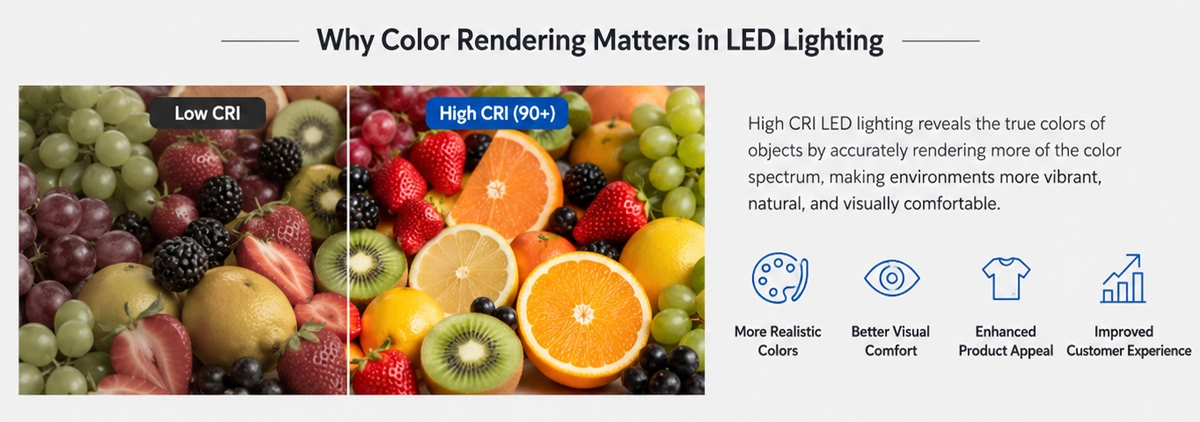
Whether you are designing a supermarket, a boutique, a museum, a studio, or a residential interior, your clients judge the result by how real things look under your luminaires.
Here is the trap: CRI alone does not tell the whole story. Two LED strips both labeled “CRI 90” can render deep red, skin tones, and saturated colors in completely different ways. That is why experienced specifiers now evaluate four things together: CRI, R9, TM-30, and SDCM.
Key takeaways
- CRI measures how accurately a light source reproduces colors.
- CRI 90+ is the preferred baseline for professional LED strip lighting.
- R9 drives how well skin tones, food displays, and warm materials render.
- SDCM determines color consistency across your entire installation.
- TM-30 (Rf and Rg) gives you a more advanced read on light quality.
02What You Actually See Is Determined by the Spectrum
Your eyes never see the color of an object directly. You see the portion of the spectrum that a light source emits and the surface reflects back at you. So the spectral quality of your source decides whether colors read as natural or distorted.
Sunlight is your reference standard because it delivers a smooth, continuous spectrum across the visible range — which is why colors outdoors look balanced, vivid, and true. Not every LED strip produces that continuous spectrum. Lower-quality LEDs leave spectral gaps, most commonly in the deep-red wavelengths. The result: enough light on the task plane, but colors that look dull, grayish, or simply wrong.
On site, poor spectral quality shows up as: fresh meat that looks brown · skin tones that look pale · timber interiors that lose their warmth.
High-CRI LED strips solve this with optimized phosphor formulations and deliberate spectral engineering, producing a more balanced spectrum and therefore more accurate, more comfortable color.

03Your First Spec Decision: CRI Measures Accuracy, SDCM Measures Consistency
CRI (Color Rendering Index) tells you how accurately a source reproduces color against a natural reference. What it does not tell you is whether every strip you install will look the same.
That second question is answered by SDCM (Standard Deviation of Color Matching), also known as the MacAdam ellipse. SDCM quantifies how tightly the actual LED output clusters around the target chromaticity coordinates — in other words, how much variation you will see between production batches.
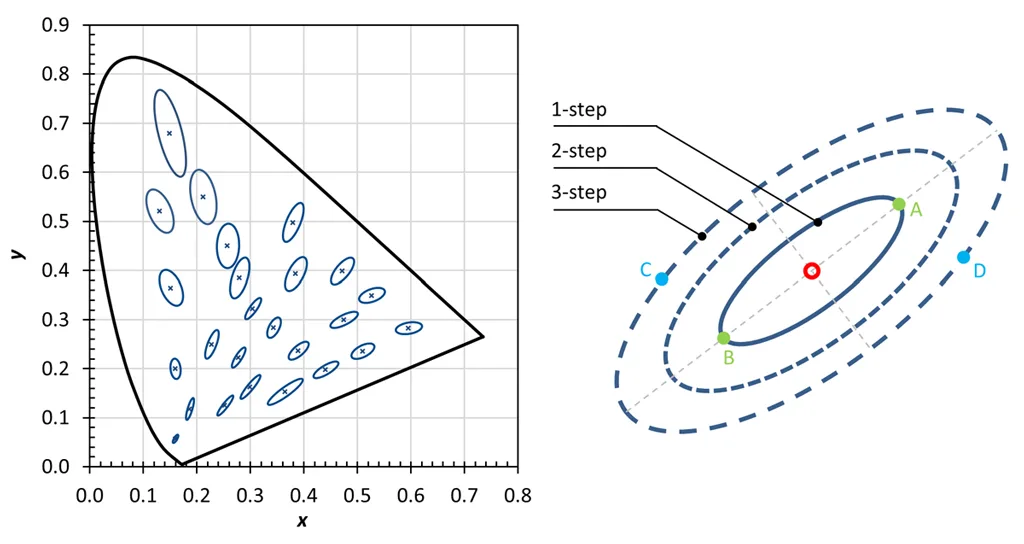
| SDCM | Color consistency | Where you would use it |
|---|---|---|
| 1–2 step | Extremely tight | Premium architectural lighting |
| 3–4 step | Standard commercial quality | Offices, retail, general commercial |
| 5–7 step | Noticeable variation between batches | Budget / non-critical installations |
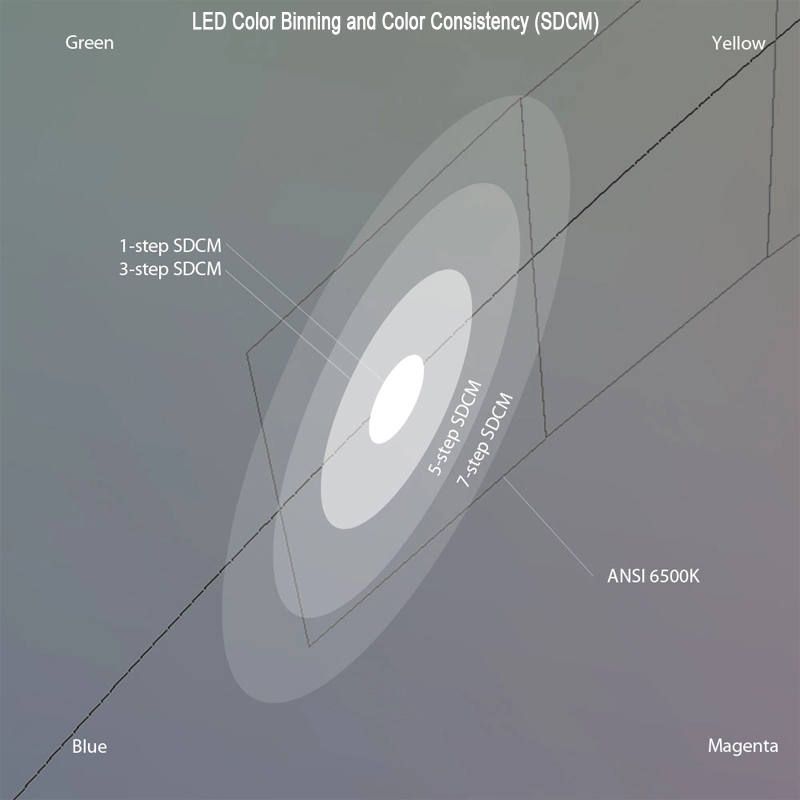
A high-CRI strip with poor SDCM control will still show visible color mismatch across a long linear run or between two purchase orders. On architectural linear lighting, retail fit-outs, and large installations, you need to specify CRI and SDCM together: one guarantees the color is right, the other guarantees it is the same everywhere.
04Do Not Let Ra Fool You: Why You Must Read R9 Separately
This is the single most common specification mistake you can make. Standard CRI is calculated from eight low-saturation test samples, R1–R8, and their average is reported as Ra. Deep red — R9 — is not included in that average.
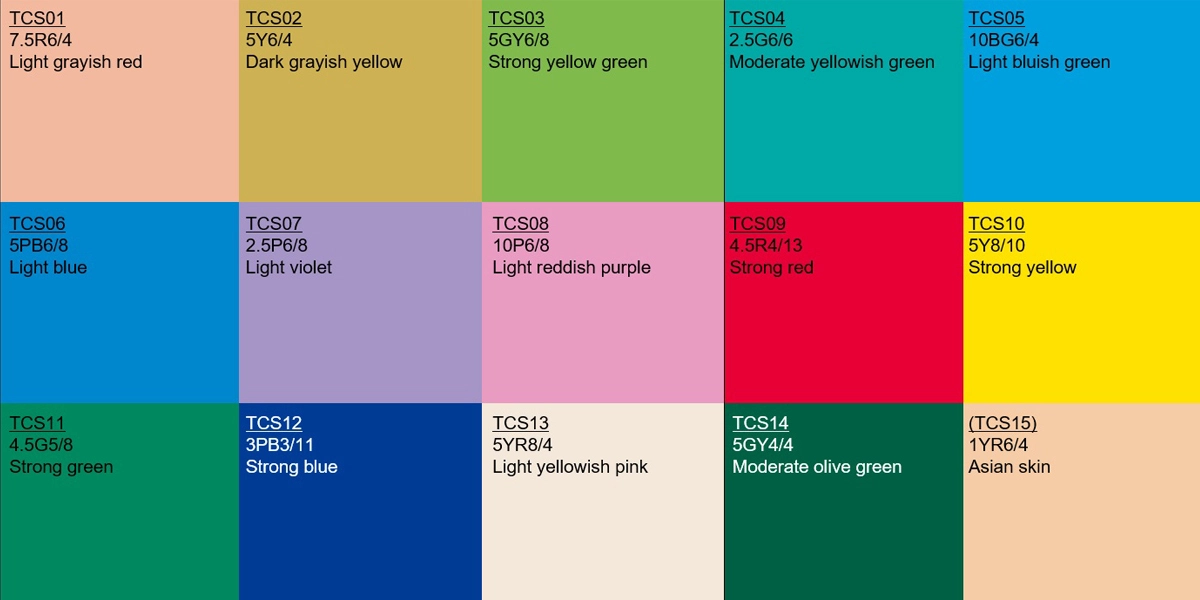
So a strip can legitimately claim CRI 90 and still render red badly. The moment your project involves fresh meat, skin tones, timber, or any warm material, that gap becomes visible on site.
Where R9 decides the outcome
- Fresh meat and protein displays
- Skin-tone lighting (hospitality, retail, studios)
- Fashion and cosmetic retail environments
- Hotels, restaurants, and lounge spaces
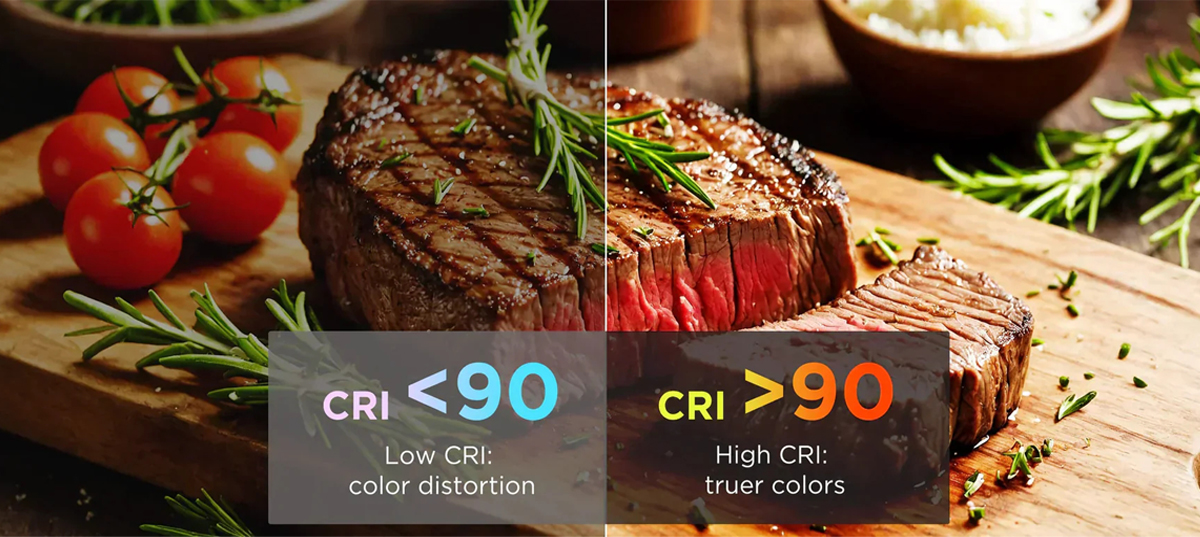
With a low-R9 LED, reds appear dull, brownish, or gray even though the CRI number looks high. With a high-R9 LED strip, you get stronger deep-red spectral output, so colors render richer, warmer, and more natural. In many commercial projects, the visual impact of R9 is greater than the CRI value itself — which is why you should always ask your supplier to declare R9, not just Ra.
05CRI 70 vs 80 vs 90 vs 95 vs 99: What You Are Really Specifying
Moving from CRI 70 to CRI 99 does not just “make things prettier.” It changes the phosphor engineering, the spectral control, and — always — the efficacy you can achieve. Higher CRI costs you lumens per watt.
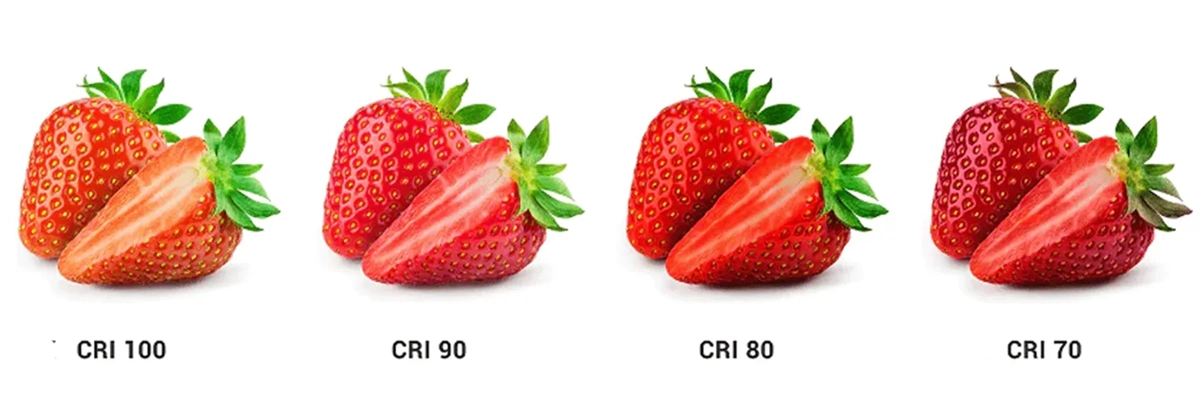
CRI 70 — basic functional lighting
Designed for efficiency and visibility, not color quality. You would specify it for industrial spaces, warehouses, and outdoor utility lighting where appearance is not the point.
CRI 80 — standard commercial baseline
The common baseline for general commercial work: offices, supermarkets, basic retail. Deep reds and warm tones, however, still read slightly weak or flat.
CRI 90 — the professional standard
Widely accepted as the ideal balance between color quality, efficacy, and cost. Colors appear richer and more natural, which is why it is the default choice for retail, hospitality, architectural, and residential projects.
CRI 95 — premium color rendering
Delivers refined color depth, smoother tonal transitions, and stronger red rendering. You would reach for it in museums, luxury retail, studios, and high-end interiors.
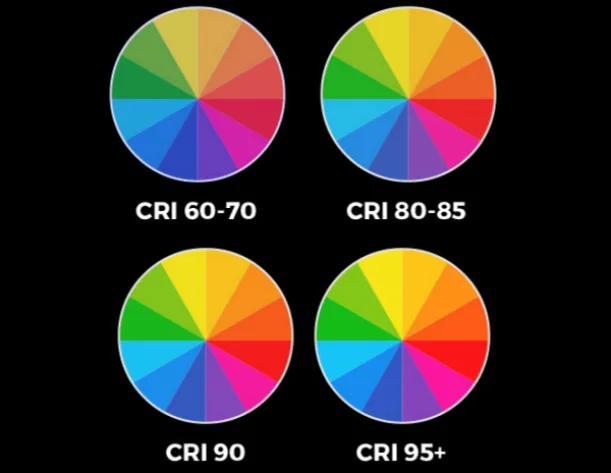
CRI 99 — full spectrum and specialized use
Engineered to reproduce a spectrum extremely close to natural sunlight. You specify it where maximum color fidelity is non-negotiable: medical, laboratory, photography, and color-critical inspection.
| CRI level | Visual quality | Typical applications |
|---|---|---|
| CRI 70 | Basic color rendering | Industrial, warehouse, outdoor lighting |
| CRI 80 | Standard commercial quality | Offices, supermarkets, general retail |
| CRI 90 | Professional-grade lighting | Retail, hospitality, residential interiors |
| CRI 95 | Premium visual performance | Museums, studios, luxury retail |
| CRI 99 | Near-sunlight color fidelity | Medical, laboratories, photography |
Your practical sweet spot: for most professional LED strip projects, CRI 90–95 gives you the best balance of visual quality, efficacy, and total project cost.
06How You Match CRI to the Application
Choosing the right CRI is not about picking the highest number — it is about matching the CRI level to the real visual demand of the space. A well-matched CRI 90 delivers more project value than an expensive, over-specified CRI 99 your client will never perceive.
| Application type | Recommended CRI | Why it matters |
|---|---|---|
| Warehouses, parking areas, industrial facilities | CRI 70–80 | Prioritizes efficiency, visibility, and cost control |
| Offices, retail stores, hospitality, residential interiors | CRI 90 | Strong balance of color quality, comfort, and efficacy |
| Museums, galleries, studios, luxury retail, premium food displays | CRI 95+ | Enhanced color depth, realism, and presentation quality |
Remember that CRI is never evaluated in isolation. R9 performance, SDCM consistency, color temperature, TM-30 metrics, and your overall lighting design all combine to determine how color is finally perceived in the space. For the majority of commercial and architectural LED strip projects, CRI 90 remains the most practical and most widely specified choice.
Specification checklist you can copy into your RFQ
When you send out a request for quotation, declaring these parameters up front prevents most on-site color disputes:
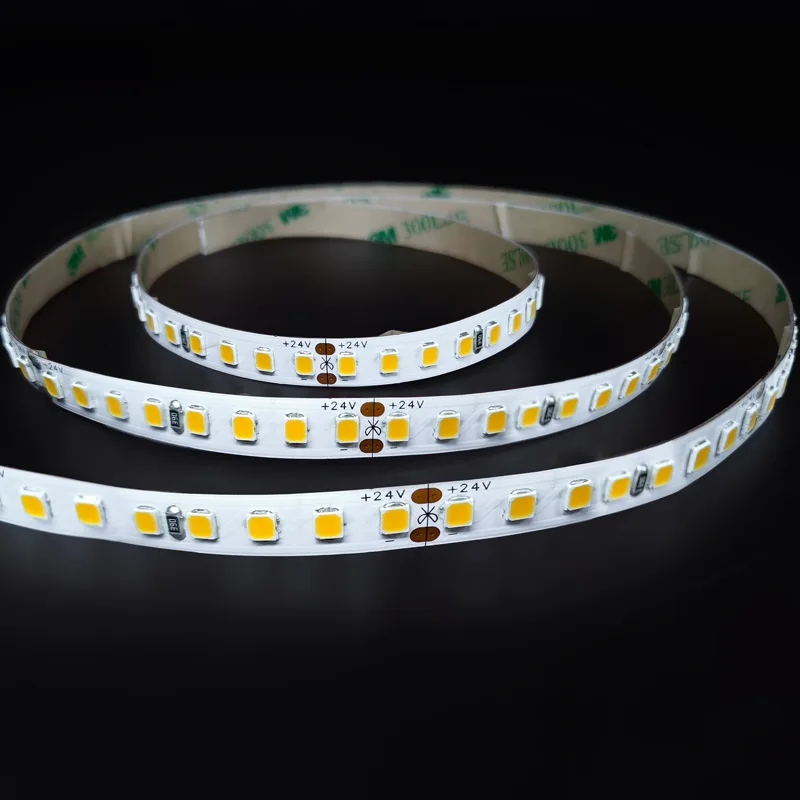
- LED density and package: e.g. 128 × SMD 2835 per meter, 10 mm PCB width
- CRI 90+ with declared R9 value
- CRI level customization if your project spans tiers: 80 / 90 / 95+
- Efficacy target: up to 200 lm/W (balance against the CRI you need)
- CCT options: 3000 K / 4000 K / 6500 K
- Single color bin, 3-step SDCM available
- Fully dimmable, compatible with your control system
- For dot-free decorative runs: 480 chips/m COB, 100 lm/W, 180° beam angle, 2700–6500 K
07Beyond CRI: What TM-30 Adds to Your Toolkit
CRI has been the industry’s default for decades, but it cannot fully describe how colors actually appear under a source. TM-30, developed by the IES (Illuminating Engineering Society), is a more advanced method that analyzes a much wider range of colors.
Instead of one fidelity average, TM-30 gives you two independent axes:
- Rf — Fidelity Index: how accurately colors are reproduced.
- Rg — Gamut Index: how saturated or vivid colors appear.
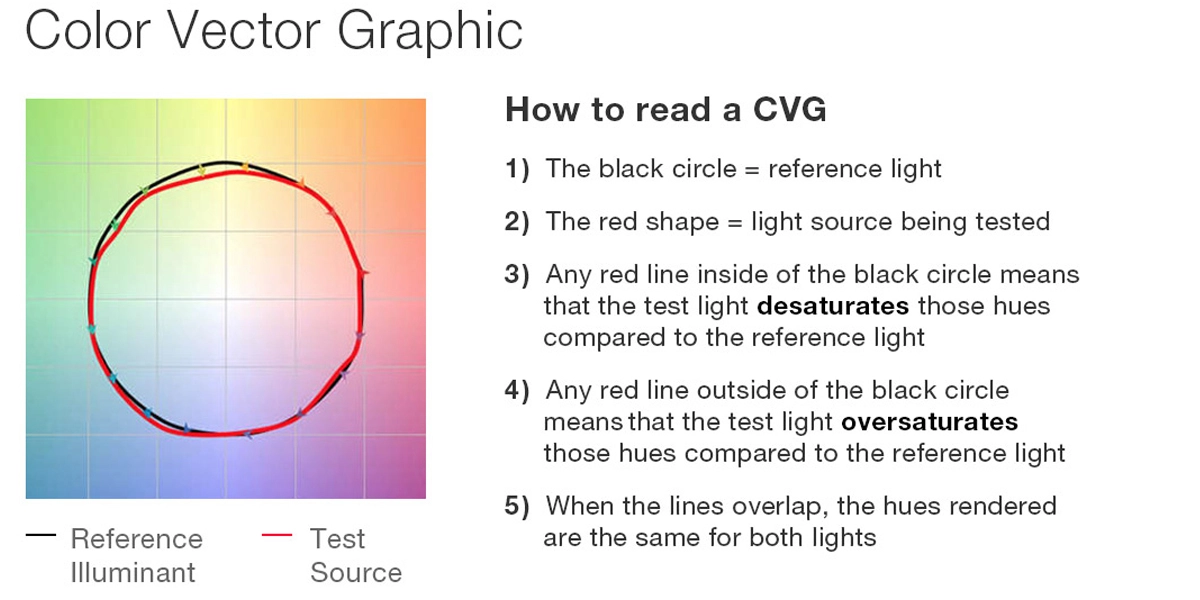
With those two numbers you can finally answer questions CRI cannot: does this source make colors look more natural, more vivid, oversaturated, or visually dull? That distinction matters most in retail lighting, architectural lighting, museum environments, hospitality projects, and premium commercial applications.
CRI still carries the most recognition across the LED industry, and TM-30 is increasingly treated as the future of professional color quality assessment. For most of your LED strip projects today, CRI + R9 + SDCM already give you a solid evaluation basis; you reach for TM-30 when the project demands a deeper layer of analysis.
08Where High CRI Pays Off in Your Projects
High-CRI LED strips are not necessary in every project. But wherever appearance directly drives customer perception, ambiance, or product presentation, color quality makes a measurable difference. Better lighting is not simply about making a space brighter — it is about making colors more natural, materials more premium, and the environment more visually comfortable.
Retail and product displays
Low-CRI lighting flattens fabrics, packaging, cosmetics, and merchandise. High-CRI strips restore natural color appearance so products look vibrant, accurate, and appealing — critical in fashion retail, jewelry, cosmetics, and luxury showcases. It also removes the “artificial” or washed-out feel that low-grade commercial lighting produces.
Food and fresh displays
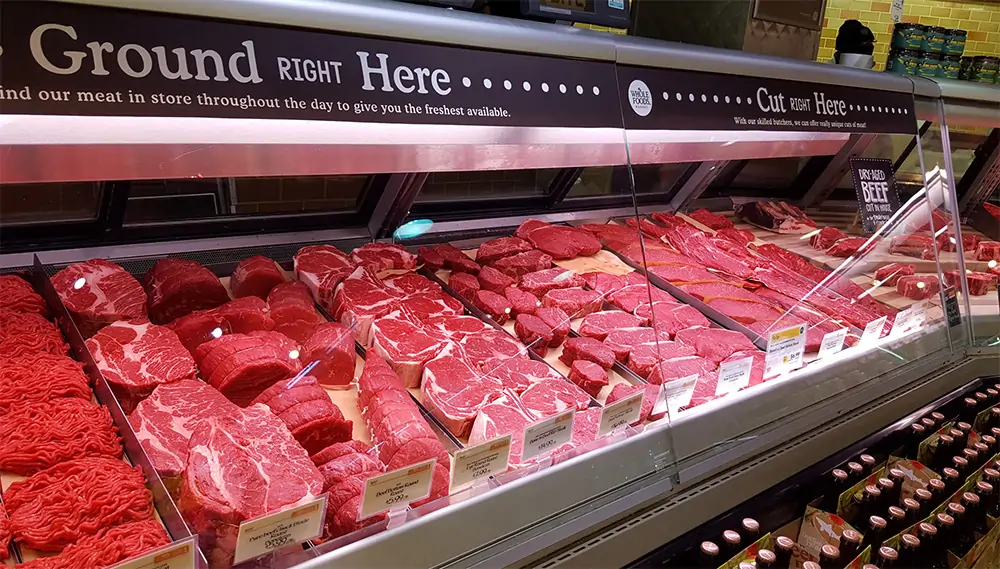
Food is one of the most color-sensitive lighting applications you will handle. Fresh meat, fruit, vegetables, baked goods, and dairy all become noticeably less appealing under poor lighting, and deep reds and warm tones are governed largely by R9 performance. A high-CRI strip with strong R9 makes food look fresher, more natural, more vibrant, and more appetizing.
Hospitality and residential interiors
Lighting quality drives atmosphere and emotional comfort. High CRI makes wood, stone, fabrics, and decorative finishes look natural and textured. Combined with warm CCTs such as 2700 K or 3000 K, high-CRI strips create softer, more comfortable, more premium interiors — valuable in architectural linear lighting, hotels, restaurants, luxury residences, and lounge spaces.
Photography, studio, and broadcast
Professional cameras are usually more sensitive to color inconsistency than the human eye. Poor-quality lighting produces green tint shifts, unnatural skin tones, poor color balance, and inconsistent video rendering. High-CRI lighting improves skin-tone accuracy and overall color realism in these environments.

Museums and art galleries
These spaces need lighting that preserves the true appearance of artwork and materials. High CRI lets viewers experience color, texture, and fine detail accurately while keeping the environment visually comfortable. In high-end exhibition settings, lighting consistency and spectral quality are often as important as brightness itself.

09Why Higher CRI Is Harder to Manufacture — and What It Costs You
Pushing a CRI number higher is not a simple spec change. As CRI rises, the manufacturer must deliver a more balanced spectrum while holding color consistency, thermal stability, and efficacy at the same time. Beyond CRI 90 the challenge escalates sharply: rendering deep red, skin tones, wood grain, and warm materials accurately demands much tighter spectral control.
| CRI level | Spectral requirement | Manufacturing difficulty | Typical efficiency | Common applications |
|---|---|---|---|---|
| CRI 70–80 | Basic color rendering | Low | Higher lm/W | Industrial, utility, basic commercial |
| CRI 90 | Improved red-spectrum balance | Medium | Moderate efficiency | Retail, hospitality, architectural |
| CRI 95+ | Advanced full-spectrum tuning | High | Slightly lower efficiency | Museums, luxury retail, studios |
| CRI 99 | Near sunlight-level spectral precision | Very high | Lowest efficiency | Medical, laboratory, color-critical |
Delivering high-CRI LED lighting consistently requires four things from your supplier: more advanced phosphor engineering, tighter LED binning control, better spectral consistency, and more stable thermal management. This is also one reason high-density COB LED strip technology is gaining ground in premium architectural projects — it delivers smoother light output and improved visual uniformity.
10Frequently Asked Questions
Is CRI 80 good enough for LED strip lights?
CRI 80 is generally acceptable for basic residential and commercial lighting where color accuracy is not a primary concern. But for retail displays, hospitality spaces, food presentation, and architectural lighting, you will usually get noticeably better rendering and visual comfort from CRI 90 or higher.
Is CRI 90 worth it for LED strip lighting?
For most professional LED strip projects, yes. CRI 90 offers an excellent balance of color quality, efficacy, and cost, and it visibly improves skin tones, material textures, and overall appearance — which is exactly why it is the popular default for retail, hospitality, and architectural work.
What is the difference between CRI and R9?
CRI measures overall color rendering using standard test samples; R9 specifically evaluates the accuracy of deep red colors. Because red tones strongly affect food displays, skin tones, wood finishes, and warm materials, R9 is increasingly important in your professional evaluation.
Does higher CRI reduce brightness?
In general, yes. High-CRI LED lighting requires a broader, more balanced spectrum — especially stronger red output — which typically results in slightly lower luminous efficacy than low-CRI LEDs. Many professional projects accept that trade because visual quality matters more than maximum lumens per watt.
What CRI is best for retail display lighting?
Retail display lighting is usually best specified at CRI 90 or above, which helps products look more vibrant, natural, and appealing. It is particularly important in fashion retail, cosmetics, jewelry, and luxury showcases.
Is CRI 95 better than CRI 90?
CRI 95 can deliver more refined and accurate color rendering than CRI 90, especially in museums, photography, studio lighting, and luxury retail. For many standard commercial applications, however, CRI 90 already provides excellent visual performance — the extra cost is not always justified.
Do COB LED strips usually have better color quality?
Many high-end COB LED strips are designed with high CRI performance and better visual uniformity in mind. Compared with traditional SMD strips, COB technology can provide smoother light output and more comfortable linear illumination — but the actual color quality still depends on CRI, R9, phosphor quality, and manufacturing consistency.
Final Thoughts
High-CRI LED strip lights play a critical role wherever color accuracy, visual comfort, and product presentation directly shape user experience and commercial value — from retail displays to hospitality, office environments, and architectural lighting. Selecting the right CRI level ensures the best visual performance while balancing cost, efficiency, and long-term reliability.
Modern lighting design is moving away from specification-based selection toward application-driven decision-making. In that model, your outcome is decided by how well you combine CRI performance, LED quality, and system consistency — not by any single number on a datasheet.
Need help specifying the right high-CRI LED strip?
Whether you are defining CRI level, PCB design, LED density, or installation environment, your specification should be built around the application — and around a supplier who can declare R9, hold SDCM, and prove it with test data.