LED Lighting Terminology:
The Ultimate Technical Glossary
A complete, plain-English reference to the terms specifiers, installers and buyers meet on every datasheet — organized by topic so you can find what you need fast, then drill down to the exact definition.
Lighting Fundamentals & Photometry
Lumens, illuminance, luminance and power – the vocabulary behind every spec sheet.
Accommodation
Brightness
Candela
*Analogy:* Think of a laser pointer vs. a light bulb. The bulb has higher lumens (total light), but the laser has higher candela (intensity) because all its energy is focused in one tight beam. This unit is crucial for specifying spotlights and flashlights.
Direct lighting
Pros: Highly efficient for task visibility (kitchen islands, desks).
Cons: Can create harsh shadows and “cave effect” (dark ceilings) if used without any indirect or ambient lighting layers.
Eye Comfort
Key Criteria:
Flicker & Stroboscopic Effect: No visible or invisible flashing that causes headaches.
Glare: Low UGR (Unified Glare Rating) to prevent dazzling.
Photobiological Safety: No harmful blue light hazard (RG0).
Color Rendering: Natural color representation.
*Note:* Brands like Philips (Signify) have popularized this term to help consumers choose high-quality LEDs over cheap, straining alternatives.
Flicker
Consequences: Poor quality drivers can cause stroboscopic effects, leading to eye strain, headaches, and even epileptic seizures in sensitive individuals (IEEE 1789 Standard).
Solution: Always specify “Flicker-Free” drivers for offices, schools, and video recording studios (to prevent banding lines on camera).
Foot-candle
Conversion: 1 fc ≈ 10.76 lux. While the rest of the world uses Lux, the US lighting market primarily uses Foot-candles. For example, a standard office desk requirement might be 50 fc (approx. 500 lux).
Illuminance
Key Concept: Do not confuse with “Luminous Flux” (Lumens). Lumens is the light leaving the bulb; Illuminance is the light hitting the desk. *Formula:* 1 Lux = 1 Lumen per square meter.
Indirect lighting
Benefits: By using the ceiling as a giant reflector, the light becomes incredibly soft and shadow-free. This creates a calm atmosphere and completely eliminates direct Glare, making it popular in bedrooms, lounges, and high-end offices.
Lumen
Analogy: Think of lumens as the “gallons of water” coming out of a hose.
Usage: When buying a light, look at Lumens for “Quantity of Light,” not Watts. A 10W LED might produce the same Lumens (800lm) as a 60W Incandescent bulb.
Luminance
Perception: It quantifies how bright a surface looks to the human eye.
*Example:* A small light source emitting 1000 lumens will have high luminance (painfully bright to look at). A large panel light emitting the same 1000 lumens will have low luminance (soft and comfortable). It is key to assessing Glare.
Lux
Formula: 1 Lux = 1 Lumen per square meter.
Analogy: If Lumens are the water coming out of the hose, Lux is how wet the grass gets.
Standards:
Warehouse floor: ~150-200 Lux.
Office desk: ~500 Lux.
Precision drawing/surgery: >1000 Lux.
Output (Lumen Output)
The “Trap”: Be careful to distinguish between:
Source Output: The theoretical brightness of the LED chip alone (e.g., 1000lm).
Fixture Output (Delivered Lumens): The actual light that comes out of the fixture after passing through the Optics and Diffuser (e.g., 800lm).
*Note:* The difference is caused by the “Light Output Ratio” (LOR). Honest manufacturers always list the Deliverd Lumens (Fixture Output).
Photometry
Relevance: Unlike “Radiometry” (which measures total energy), Photometry applies a weighting function (the luminosity function) because human eyes are more sensitive to green light than blue or red.
Tools: Measurements are taken using a Goniophotometer or Integrating Sphere to generate reports on Lumens, CCT, and CRI.
Power
The Shift: In the incandescent era, Watts equaled Brightness. In the LED era, Watts only equals “Consumption.” To judge brightness, you must look at Lumens.
*Formula:* Power (W) = Voltage (V) × Current (A) (in DC circuits).
Power Factor
Why it matters:
Low PF (<0.5): Cheap drivers waste energy in the distribution lines. Utility companies often penalize commercial buildings for low PF.
High PF (>0.9): Required for most commercial/industrial LED projects (DLC standards). It indicates an efficient, high-quality Driver.
Ripple
Effect: High ripple current causes the LED light output to fluctuate rapidly, leading to Flicker.
Quality Indicator: A high-quality “Flicker-Free” driver will have sophisticated filtering capacitors to minimize ripple current to negligible levels (e.g., <5%).
THD
The Standard: Lower is better.
THD < 10%: Excellent. Required for high-end projects and strict energy codes.
THD < 20%: Standard for commercial lighting.
THD > 20%: Low quality. High THD can cause interference with other electronics and overheating of the building’s neutral wires.
Uniformity
Why it matters:
Low Uniformity: Creates “hotspots” (bright patches) and shadows. The human eye tires quickly because it must constantly adapt between light and dark areas.
Good Uniformity: The light looks smooth. For offices, a ratio of > 0.6 is typically required; for sports fields, > 0.7.
Volumetric Lighting
Goal: It ensures that walls, ceilings, and the faces of people in the room are well-lit.
Why it matters: Standard Direct Lighting (like recessed downlights) often creates a “Cave Effect” (bright desks, dark upper walls). Volumetric lighting uses diffuse or Direct/Indirect fixtures to fill the room with light, making the space feel larger, airier, and more comfortable.
Wattage
The Old Rule: In the past, a “60W bulb” described brightness.
The New Rule: In the LED era, Watts only tells you your electricity bill. To judge brightness, you must look at Lumens. A 10W LED can be as bright as a 60W incandescent.
Working Plane
Standard Heights:
Office/School: Desk height, typically 0.76 meters (30 inches) above the floor.
Corridor: The floor level (0 meters).
Design: When a standard requires “500 Lux,” it means “500 Lux at the Working Plane,” not on the ceiling.
Color & Light Quality
CCT, CRI/R9, TM-30, MacAdam ellipses and SPD – what makes light look right.
BBL (Planckian Locus)
Binning
Why it matters: High-quality LED fixtures use “Tight Binning” (e.g., within a 3-step MacAdam Ellipse) to ensure that if you install 50 lights in a corridor, they all emit the exact same color of light without visible variation.
Color consistency
Color Gamut
CRI (Ra)
Standard LED (CRI 80): Good for general offices and street lights.
High CRI (CRI 90+): Essential for retail stores, museums, and art galleries where color accuracy is paramount (e.g., distinguishing navy blue from black).
*Note:* Standard CRI often ignores red (R9), so look for “CRI 90+ with High R9” for best results.
Kelvin
The Scale:
Lower Kelvin (e.g., 2700K – 3000K): Emits a “Warm” yellowish/orange light, similar to sunrise or incandescent bulbs. Ideal for relaxation (Homes, Restaurants).
Higher Kelvin (e.g., 5000K – 6500K): Emits a “Cool” bluish-white light, similar to noon daylight. Ideal for concentration (Offices, Hospitals, Industrial).
*Rule of Thumb:* The higher the Kelvin value, the “cooler” the light looks; the lower the value, the “warmer” it feels.
MacAdam Ellipse
1-Step MacAdam: No visible color difference. (Lab grade).
3-Step MacAdam (SDCM < 3): The standard for high-end professional lighting. The eye can barely see a difference between two fixtures.
5-Step or 7-Step: Common in cheap hardware store bulbs. You might buy two “3000K” bulbs, but one looks pink and the other looks yellow.
Monochromatic light
Examples:
Red/Green/Blue LEDs: Pure saturated colors used in signage or RGB mixing.
Amber: Used in turtle-friendly lighting.
Contrast: “White” LED light is *not* monochromatic; it is a mixture of blue light and yellow phosphor emission (Polychromatic).
Nanometer (nm)
The Visible Spectrum:
Blue: ~450-495 nm (High energy, controls circadian rhythm).
Green: ~495-570 nm (Most sensitive to the human eye).
Red: ~620-750 nm (Essential for plant growth/horticulture).
*Note:* UV light is <400 nm, and Infrared is >700 nm; both are invisible to the human eye but have specific industrial applications.
Neutral White
Characteristics: It sits between “Warm White” (yellowish) and “Cool White” (bluish). It appears crisp, clean, and modern without being sterile.
Best For: Offices, retail stores, kitchens, and bathrooms. It is the preferred choice for commercial spaces because it provides good contrast for reading and working without causing drowsiness.
Planckian Locus
*Note:* This term is the scientific basis for Color Temperature (Kelvin). High-quality white LEDs should have chromaticity coordinates that fall exactly on or very close to this locus.
R9
The Problem: The standard CRI (Ra) calculation only averages colors R1 through R8 (which are pastel colors). It completely ignores R9 (Red).
Why it matters: A standard LED can have a high CRI (Ra 80) but a terrible R9 (even negative values), making skin tones look pale/greenish and meats look brown.
Standard:
Commercial: R9 > 0 is acceptable.
High-End Retail/Hospitality: R9 > 50 is recommended.
Medical/Art: R9 > 90 is required for critical color discrimination.
Ra
Calculation: It is the arithmetic average of the color deviation of the first 8 test color samples (TCS R1 to R8) compared to a reference source.
Limitation: Because it is an average of unsaturated colors, Ra is not a perfect metric. Two lights can both be “CRI 80” but look completely different. This is why professional lighting designers also look at R9 and TM-30 data.
RGB / RGBW
RGB: Red, Green, and Blue chips. By mixing these three, you can create millions of colors. *Problem:* Mixing all three to create “White” often results in a weird, low-quality pinkish or bluish white.
RGBW: Adds a dedicated White chip (either 3000K or 4000K). *Benefit:* This allows for pure, high-quality white light for normal illumination, plus the ability to create pastel colors and saturated effects.
Application: Facade lighting, stage lighting, and smart home strips.
Saturation
High Saturation: Vivid, deep, and pure colors (e.g., a bright laser red).
Low Saturation: Washed out, grayish, or pastel colors.
Lighting Context: High-quality LEDs (like those with RGBW chips) are capable of producing highly saturated colors for architectural facades, whereas traditional metal halide lamps often struggle to produce deep reds or blues without filters.
SDCM
The Scale:
< 3 SDCM: The industry standard for professional/commercial lighting. The human eye can barely detect any difference between fixtures.
< 5 SDCM: Acceptable for general residential use.
> 7 SDCM: Visible color mismatch (e.g., one light looks pink, the other looks yellow).
SPD (Color Spectrum)
TM-30 (IES TM-30)
Two Key Metrics:
Rf (Fidelity): Similar to CRI. How accurately does it match the reference? (0-100).
Rg (Gamut): Saturation. Does the light make colors vivid or dull?
Rg = 100: Natural saturation.
Rg > 100: Colors look oversaturated (Vivid).
Visual: It generates a “Color Vector Graphic” (circle chart) that visually shows designers which colors are enhanced or muted.
Tunable White
Difference: Unlike “Dim-to-Warm” (which is fixed), Tunable White lets you have “dim cool light” or “bright warm light.”
Application: The core technology behind Human Centric Lighting (HCL) to support circadian rhythms.
Warm Dim (Dim-to-Warm)
Application: Perfect for hospitality settings like restaurants, bars, and luxury homes to create an intimate atmosphere in the evening.
Wavelength
Spectrum:
Blue: Short wavelength (~450nm). High energy.
Red: Long wavelength (~650nm). Lower energy.
Relevance: LED manufacturers adjust the semiconductor materials to tune the wavelength, allowing for the creation of specific colors for horticulture (Grow Lights) or human-centric lighting.
Optics, Materials & Light Distribution
Lenses, reflectors, diffusers and beam shaping – where the light goes and how soft it is.
Asymmetric distribution
Beam angle
Narrow Beam (<20°): Used for highlighting specific objects (Accent Lighting).
Wide Beam (>40°): Used for general illumination (Ambient Lighting).
*Tip:* Do not confuse this with “Field Angle,” which measures the spread up to 10% of max intensity.
Cut-off Angle
Significance: A larger cut-off angle (e.g., >30° or >40°) means the light source is deeply recessed. This “Dark Light” effect significantly reduces glare and improves visual comfort, as you can see the light on the floor but not the bright source on the ceiling.
Diffuser
Purpose:
Reduce Glare: Softens the harsh intensity of the LED chip.
Uniformity: Hides the individual “hotspots” or dots of the LED strip, creating a smooth, continuous line of light (essential for linear lighting).
Facade lighting
Wall Washing: Uniformly lighting a surface to smooth out textures.
Wall Grazing: Placing lights close to the wall to emphasize textures (like brick or stone).
Media Facade: Using thousands of addressable LED nodes (pixels) to turn the building into a low-resolution video screen.
*Note:* Requires high IP Ratings (IP66+) due to outdoor exposure.
Field Angle
Comparison: Do not confuse this with Beam Angle (which measures the 50% drop).
Beam Angle: The bright “core” of the light.
Field Angle: The entire “spill” of light, including the fainter edges.
Design Tip: If the Field Angle is significantly larger than the Beam Angle, the light has a “soft edge.” If they are close in number, the light has a “hard edge” (sharp cutoff).
Ghosting
Cause: This typically happens when using fixtures with multiple discrete light sources (like an SMD LED array) behind a clear cover. Each individual LED chip casts its own shadow.
Solution: To avoid ghosting, use COB (Chip on Board) LEDs which act as a single point source, or use frosted Diffusers to blend the light before it leaves the fixture.
Glare
Key Metric: UGR (Unified Glare Rating).
UGR < 19: Required for offices and schools (Low glare, comfortable for reading).
UGR < 22: Acceptable for general commercial areas.
UGR > 28: Uncomfortable, often found in industrial settings or outdoor floodlights.
Control: Glare is reduced by using deep reflectors, honeycomb louvers, or frosted lenses.
Lens
Function: It shapes the light output from the LED’s natural 120° spread into specific Beam Angles (e.g., 15° Spot, 60° Flood, or oval shapes).
TIR Lens: “Total Internal Reflection” lenses are high-efficiency optics used in directional spotlights to capture and redirect virtually all light rays, minimizing loss.
Louver
Purpose: Its primary goal is Glare Control. By physically blocking the view of the bright light source from shallow viewing angles, louvers ensure that the light is directed downwards and not into people’s eyes.
Narrow Beam
Application: It is used for Accent Lighting to highlight specific objects (like a statue, vase, or company logo) or architectural columns.
Physics: By concentrating the light into a small area, a narrow beam fixture produces very high Candela (Center Beam Candlepower), making the object “pop” out from the background, even if the total Lumen output of the lamp is low.
Optics
Common Types:
Reflectors: Shiny cones (often aluminum) that bounce light forward. Good for general downlights.
Lenses: PMMA or PC materials that refract light using Total Internal Reflection (TIR). Best for precise spotlights and maximizing efficiency.
Diffusers: Milky covers that scatter light to hide the LED dots.
Importance: High-quality optics ensure a clean Beam Angle without “artifacts” or stray halos.
PMMA
Key Properties:
Clarity: Extremely high light transmission (up to 92%), better than glass.
UV Stability: Does not yellow easily when exposed to sunlight/UV.
Weakness: Brittle (cracks easily on impact) compared to Polycarbonate.
Polycarbonate (PC)
Key Properties:
Strength: Virtually unbreakable (used in bulletproof glass). High IK Rating (IK10) fixtures always use PC covers.
Safety: High flammability resistance (UL94 V-0), often required for public buildings.
Weakness: Lower light transmission than PMMA and tends to turn yellow over time under UV exposure unless treated with special UV stabilizers.
Reflector
Function: It surrounds the LED chip to catch light rays emitted to the side and redirect them forward.
Character: Compared to a Lens (TIR), a reflector usually produces a “softer” beam with more “spill light” (a gradual fade at the edges), which is often preferred for general ambient lighting in offices and homes.
Specular Reflection
Lighting Design: Highly polished floors or glossy tables create specular reflection. If a Downlight is placed incorrectly above such a surface, it will create a blinding reflected image of the light source (Reflected Glare), causing visual discomfort.
UGR
Key Thresholds:
UGR < 19: The gold standard for Offices, schools, and reading tasks. It ensures no eye strain during long working hours.
UGR < 22: Acceptable for retail and reception areas.
UGR > 25/28: High glare, acceptable only for corridors or industrial halls where people keep moving.
Design: Low UGR is achieved using Honeycomb Louvers, prismatic diffusers, or deeply recessed light sources.
Uplight
Applications:
Indoor: Used for Indirect Lighting to bounce light off the ceiling, creating a soft, glare-free ambience.
Outdoor: Used for landscape lighting (illuminating trees) or facade lighting (columns).
Concern: In outdoor settings, excessive uplight contributes to Light Pollution (Sky Glow). “Dark Sky Friendly” fixtures restrict uplight.
Wall Grazing
Effect: This angle creates high-contrast shadows on the wall’s surface, dramatically highlighting textures like stone, brick, wood, or stucco.
Contrast: Unlike “Wall Washing” (which flattens texture for a smooth look), Grazing is all about emphasizing the physical depth and material character of the architecture.
Wall Washer
Function: It “washes” the wall with light, smoothing out any imperfections and eliminating shadows.
Visual Effect: By making vertical surfaces bright, it makes a room feel significantly more spacious and airy.
Contrast: Unlike Wall Grazing (which emphasizes texture by skimming light close to the wall), Wall Washing places the fixture further away (typically > 1 meter) to flatten the texture.
Wide Beam
Usage: Used for Ambient Lighting or General Lighting to spread light evenly across a room without creating harsh shadows or spotlights.
Fixture Types: Most Panel Lights, Linear Lights, and general Downlights use a wide beam.
LED & Light Sources
Chip packages (SMD/COB), modules and solid-state lighting basics.
COB
Advantages: Superior heat dissipation, high lumen density, and a uniform beam without “multi-shadowing,” making it the preferred choice for spotlights, track lights, and high-bay fixtures.
Lamp
Distinction: A “Luminaire” is the whole fixture; the “Lamp” is just the glowing part inside.
LED Context: In modern integrated LED fixtures, there is often no replaceable “lamp”; the light source is a module permanently built into the housing.
LED
Advantages: Compared to incandescent or fluorescent sources, LEDs are vastly more efficient (high Efficacy), have a longer lifespan, are physically durable (shock-resistant), and offer instant-on capability without warm-up time.
LED Module (Light Engine)
Context: It is the “middle state” between a raw LED chip and a finished Luminaire. In many modern fixtures, the LED module is replaceable (Zhaga standard) to support the “Right to Repair” and circular economy.
Light Source
Common Types:
SMD (Surface Mounted Device): Small, individual chips mounted on a PCB. Great for light strips and panels.
COB (Chip on Board): A dense cluster of chips bonded together. Great for spotlights requiring high intensity.
High Power LED: Discrete, large chips used for street lights.
*Note:* The quality of the Light Source (e.g., Cree, Osram, Nichia) directly dictates the CRI and Binning precision.
OLED
Features:
Glare-Free: Because the light comes from a large flat surface, it is naturally soft and diffuse, requiring no additional diffusers.
Flexible: The panels can be extremely thin, bendable, or even transparent.
Application: While famous in TV screens, in general lighting, OLEDs are used in high-end, futuristic architectural panels and decorative mirror lights.
SMD LEDs
Naming: Often named by their dimensions, e.g., SMD 2835 (2.8mm x 3.5mm) or SMD 5050.
Pros: Efficient, excellent heat dissipation, and wide viewing angle (typically 120°). Used in LED strips, panel lights, and bulbs.
Contrast: Unlike COB (which acts as a single large point), SMDs are multiple discrete points of light.
SSL
Meaning: “Solid State” means the light is generated within a solid block of matter, rather than from a filament (Incandescent) or a gas discharge (Fluorescent/Neon). This makes SSL devices much more robust and resistant to shock and vibration.
Drivers, Electrical & Power
Drivers, constant-current/voltage, dimming protocols and electrical safety.
Constant Current
Application: Most high-power LED fixtures (downlights, street lights, panel lights) use Constant Current drivers because LEDs are current-driven devices. This method ensures consistent brightness and prevents thermal runaway.
Constant Voltage
Application: Primarily used for flexible LED strips, linear modules, and sign lighting. These products have built-in resistors to regulate current, allowing the user to cut the strip to length without affecting the rest of the circuit.
Controller
Dimming: 0-10V, Triac, or DALI controllers to adjust brightness.
Color Control: RGB/RGBW controllers to change colors.
Smart Control: Systems like Casambis or Zigbee that allow control via smartphone apps or voice assistants.
EMC
Why it matters: LED drivers operate at high switching frequencies. Without proper EMC filtering, they can interfere with radios, Wi-Fi signals, or sensitive medical equipment. Compliance standards (like FCC in the US or CISPR 15 in Europe) are mandatory to ensure the lights don’t turn your radio into static noise.
Frequency
50Hz: Used in Europe, Asia, Australia, etc.
60Hz: Used in North America (USA, Canada), parts of South America.
Relevance: High-quality “Universal Voltage” LED Drivers are designed to operate safely on both 50Hz and 60Hz (e.g., 100-277V AC, 50/60Hz), making them suitable for global export.
Input Voltage
AC 100-277V: “Universal Voltage,” standard for commercial fixtures globally.
AC 220-240V: Specific to Europe, Asia, and Australia.
DC 12V/24V: Low voltage, used for LED strips and landscape lighting (requires an external transformer). Safety: Connecting a 12V LED strip directly to 220V AC mains will instantly destroy the LEDs.
Junction Box
Function:
Safety: It prevents electrical shocks and contains any sparks or heat that might result from a loose connection, preventing fires.
Compliance: Electrical codes (like the NEC in the US) strictly require that all wire connections be enclosed in an accessible box.
LED Application: For ultra-thin LED recessed downlights, the Junction Box is often a separate, detached metal box that houses the LED Driver and wiring, allowing the light to fit into very tight ceiling spaces (even under joists).
LED Driver
Key Role: A high-quality driver ensures constant current to prevent the LED from overheating or flickering, directly influencing the lifespan and reliability of the fixture.
PCB
Crucial Detail: High-power LEDs almost always use MCPCB (Metal Core PCB), usually aluminum or copper based.
Why? Standard fiberglass (FR4) boards act as insulators, trapping heat. Metal core boards conduct heat away from the LED chip to the Heat Sink, which is vital for maintaining a low Junction Temperature.
Surge Protection
Ratings:
Indoor: Typically 1kV – 2kV.
Outdoor (Street Lights): Must be 10kV or 20kV.
Importance: Without adequate surge protection, a single thunderstorm can destroy an entire street of LED lamps.
Transformer
Lighting Context:
Old Tech: Used for 12V Halogen lamps (AC to AC).
LED Context: Most LEDs operate on DC and require a Driver, not a transformer. However, “Electronic Transformers” are sometimes used for low-voltage LED strips (AC 220V to DC 12V/24V), though technically these are Power Supplies.
*Warning:* Using an old magnetic transformer with new LEDs often causes flickering.
Thermal Management & Lifetime
Heat is the enemy of LEDs; this is how longevity and lumen maintenance are engineered.
Average Life (or Rated Life)
Die-casting
Relevance: It is the standard method for producing high-quality LED housings and heat sinks. Die-cast aluminum offers an excellent balance of thermal conductivity (to cool the LEDs), structural strength, and corrosion resistance, making it superior to stamped sheet metal or plastic.
Extrusion
Heat Sink
Why it is critical: Unlike incandescent bulbs that radiate heat outwards, LEDs conduct heat backwards. If a heat sink is undersized or poorly designed, the LED’s junction temperature will rise, causing rapid Lumen Depreciation (dimming) and early failure. The “fins” on a heat sink are designed to maximize surface area for faster cooling.
Injection Molding
Comparison: While Die-casting (using metal) creates stronger, heat-conductive housings, injection molding is faster, cheaper, and allows for complex transparent optical shapes.
Junction Temperature (Tj)
Significance: It is the single most critical factor affecting LED life and performance.
The Rule: The cooler the (Tj), the longer the LED lasts and the brighter it stays.
Impact: If (Tj) exceeds the manufacturer’s limit (typically 85℃ to 125℃), the LED will suffer from permanent brightness loss (Lumen Depreciation) and color shift (turning blue or pink).
Note: (Tj) cannot be measured directly with a thermometer; it is calculated based on the Case Temperature (Tc) and the efficiency of the Heat Sink.
L70 / L90
L70: The point in time (in hours) when the LED’s light output has dropped to 70% of its original value. This is the industry standard for “End of Life” because the human eye can barely detect a 30% loss.
Example: “L70 > 50,000 hours” means the light will still be 70% bright after 50,000 hours of use.
L90: A stricter standard (90% remaining), often required for museums or high-end retail where consistent brightness is critical.
Lifetime
Measurement: It is usually defined by the L70 standard (e.g., 50,000 hours).
Critical Factors: LED lifetime is not determined by the chip alone but is heavily dependent on the Driver quality and Heat Sink efficiency (Thermal Management). If the driver fails or the junction temperature gets too high, the “System Lifetime” will end long before the LED chip actually fails.
Maintenance Factor
Why use it? New lights are bright. Old lights get dim (due to L70 decay) and dirty (dust accumulation).
*Formula:* Planning for higher initial brightness (Over-lighting) ensures that at the “End of Life,” the room is still bright enough.
Thermal Management
Why it is vital: Although LEDs are efficient, about 60-70% of the energy is still converted into heat (not light). Unlike traditional bulbs, LEDs do not radiate heat forward (IR); the heat gets trapped at the chip level.
Solution: Efficient Heat Sinks (passive cooling), thermal interface materials (grease/pads), and high-quality PCBs are used to draw heat away from the Junction Temperature (Tj). Poor thermal management is the #1 cause of early LED failure and color shifting.
Working Temperature (Ta)
Typical Range: -20℃ to +45℃.
Risk:
Too Hot: Exceeding the max Ta will cause the Junction Temperature to spike, leading to driver failure or rapid lumen degradation.
Too Cold: LEDs actually love cold (they run more efficiently), but the Driver components (capacitors) might freeze or fail to start if not rated for extreme cold.
Fixtures, Housing & Manufacturing
From downlights to linear systems – the luminaire and how it is built.
Clips
Mounting Clips: Used to secure LED strips or aluminum profiles to a surface.
Spring Clips: The side springs on recessed downlights that hold the fixture firmly against the ceiling drywall.
T-Grid Clips: Specialized clips for securing troffer lights to dropped ceiling grids, essential for earthquake safety compliance.
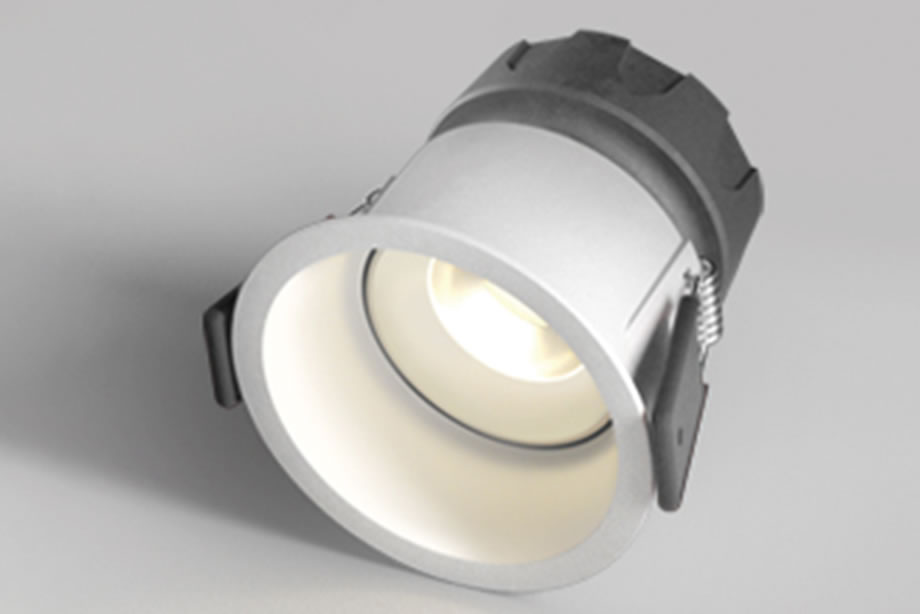
Downlight
Types:
Recessed: Sits flush with the ceiling.
Surface Mounted: Used when cutting holes in the ceiling is not possible (e.g., concrete ceilings).
Adjustable (Gimbal): The light module can be tilted to aim at a wall or artwork.
Fixture / Luminaire
Housing: The body and heat sink.
Light Source: The LED chips or module.
Optics: Lens, reflector, or diffuser.
Electronics: The LED Driver and wiring. It does not typically include the switch or the pole it is mounted on.
Floodlight
Applications: Outdoor sports fields, parking lots, architectural facades, and security lighting. Modern LED floodlights are significantly more compact and energy-efficient than traditional Halogen or Metal Halide versions, often featuring modular designs to adjust power and beam direction.
Framing Projector
Function: It allows the user to manually “cut” or shape the light beam into a perfect square, rectangle, or triangle.
Application: Exclusively used in high-end museums and art galleries. The goal is to illuminate a painting exactly to its edges with zero light spilling onto the wall behind it, creating the illusion that the artwork is self-illuminated (“Light from within”).
High Bay
Applications: Warehouses, factories, gymnasiums, and big-box retail stores.
Types:
UFO High Bay: Round, compact, and looks like a flying saucer. Popular for its durability and ease of installation.
Linear High Bay: Rectangular shape. Ideal for warehouse aisles to spread light over long rectangular racking areas.
Housing
Protection: It shields the internal components (LED chip, driver, wiring) from physical impact, dust, and moisture (determined by the IP Rating).
Thermal Path: In many LED designs, the housing itself acts as the Heat Sink, made of conductive aluminum to transfer heat to the ambient air. *Common Materials:* Die-cast aluminum (for rugged outdoor use) or Polycarbonate/Plastic (for cheaper indoor bulbs).
In-ground Light
LED Profile (Channel)
Functions:
Heat Sink: Absorbs heat from the strip to extend its life.
Diffusion: Usually includes a PC or PMMA cover (Diffuser) to spotlessness the light (dot-free).
Protection: Protects the delicate tape light from dust and physical damage.
Linear Lighting
Applications: Very popular in modern architectural design for offices, corridors, and suspended ceilings.
Forms:
Rigid: Aluminum profiles with LED boards (Linear Trunking Systems).
Flexible: LED Strip lights (Tape light).
Modular: Can be connected end-to-end to form shapes like squares, hexagons, or infinite lines.
Magnetic Track
Features:
48V Low Voltage: Safe to touch, eliminating the risk of shock.
Flexibility: Users can instantly move, add, or remove lights (spotlights, linear bars, pendants) without tools.
Aesthetics: The track is slim and often recessed into the drywall for a “trimless” look.
Panel Light
Types:
Edge-Lit: LEDs are placed on the sides of the frame. A Light Guide Plate (LGP) directs light downwards. Result: Ultra-thin (<1cm).
Back-Lit: LEDs are placed behind the diffuser. Result: Thicker, but more efficient and less prone to “yellowing” over time.
Application: The standard for modern offices, schools, and hospitals due to their uniform light output and low Glare (UGR<19 options).
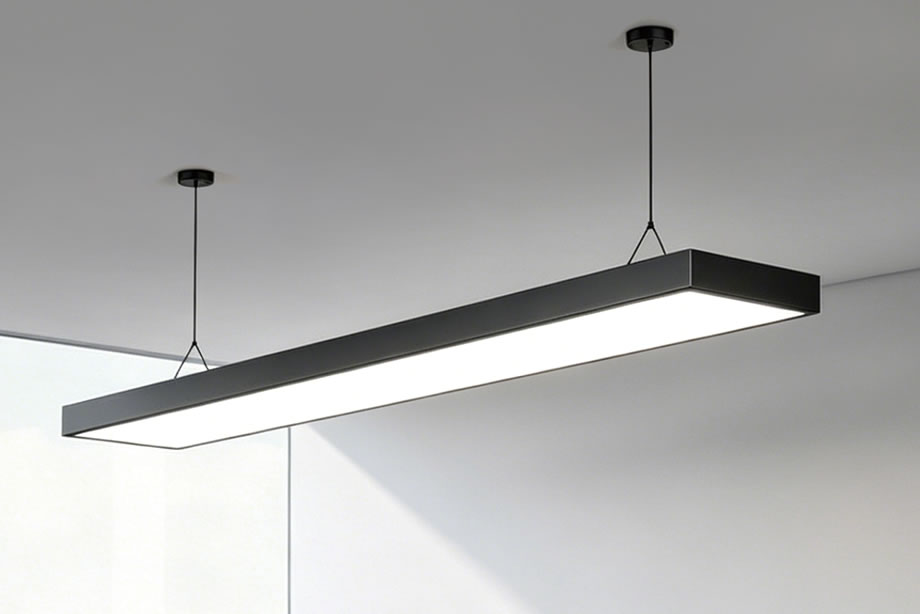
Pendant Light
Context: While often decorative (like chandeliers), in commercial LED lighting, “Linear Pendants” are functional fixtures used over office desks or conference tables.
Installation: They often require specific “Suspension Kits” (aircraft cables) that allow the installer to adjust the height precisely.
Spotlight
Characteristics: Uses a Lens or Reflector to achieve a narrow Beam Angle (usually < 45°).
Application: Used for Accent Lighting in retail stores (highlighting merchandise), museums, and stage lighting.
Track Lighting
Types:
Standard (3-wire/4-wire): Common in retail. Uses mechanical levers to lock in.
Magnetic Track: Modern, low-voltage (48V), ultra-slim.
Advantage: It offers ultimate adaptability. You can slide lights to new positions or aim Spotlights in different directions without rewiring the ceiling.
Installation & Mounting
Recessed, surface, suspended and trimless – the selection logic.
Installation
Common Types:
Recessed: Installed inside an opening (Ceiling/Wall).
Surface Mounted: Fixed directly onto the surface.
Suspended (Pendant): Hung from cables or rods. Proper installation instructions are critical for ensuring Thermal Management (leaving air gaps) and electrical safety (grounding).
Recessed lighting
Synonyms: Downlights, Can lights, Pot lights.
Aesthetics: They provide a clean, streamlined look (“Quiet Ceiling”) where the architecture stands out rather than the light fixture itself.
Safety: In insulated ceilings, you must use IC-Rated (Insulation Contact) recessed fixtures to prevent fire hazards.
Surface Mounted
Use Case: Essential for buildings with concrete ceilings (condos, lofts) where cutting holes for recessed lights is impossible. They are generally more visible and can be used as a decorative design element.
Trim / Trimless
Trim (Flanged): The fixture has a visible bezel (ring) that rests on the ceiling surface. It is easy to install and hides the rough cut edge of the drywall hole.
Trimless (Mud-in/Plaster-in): The fixture is plastered into the ceiling. After painting, there is no visible ring, just a seamless hole emitting light.
*Note:* Trimless looks far more expensive and architectural but requires significantly more labor and skill to install.
Controls, Dimming & Smart Lighting
DALI, DMX, Zigbee and human-centric lighting.
DALI
Daylight Harvesting
Benefit: This maintains a constant light level (e.g., 500 lux on a desk) while significantly reducing electricity usage during peak daylight hours.
Dimmable
Dimming curve
Linear Curve: 50% signal = 50% light. Best for accurate energy monitoring.
Logarithmic (Square Law) Curve: Best for Human Perception. Since our eyes adapt to light non-linearly, a linear drop feels too fast at the top end. A logarithmic curve creates a dimming experience that *feels* smooth and natural to the human eye.
DMX512
LED Application: It is the standard protocol for dynamic architectural lighting (e.g., color-changing RGBW facade lights on skyscrapers). Because of its high speed, DMX is required for complex light shows, pixel mapping, and music-synced lighting effects.
Human Centric Lighting
How it works:
Morning: High intensity, Cool White (e.g., 6000K) to suppress melatonin and boost alertness (Cortisol).
Evening: Low intensity, Warm White (e.g., 2700K) to trigger melatonin release and prepare the body for sleep.
Application: Increasingly standard in hospitals, schools, and modern offices to improve productivity and sleep cycles.
KNX
Key Feature: It is a decentralized system, meaning there is no single point of failure (no central computer). All devices (sensors and actuators) are “smart” and communicate directly with each other via a 2-wire bus cable. It is the preferred choice for large-scale smart building automation projects.
PIR (Sensors)
How it works: It detects changes in “heat signatures” (infrared radiation) moving across its field of view. When a warm body (human) passes in front of the cooler background, the sensor triggers the light.
Pros/Cons: Highly energy-efficient and cheap. However, it requires a “line of sight” (cannot see through walls) and is less sensitive to very small movements compared to Microwave or Ultrasonic sensors.
PWM
Dimming: To dim the light to 50%, the LED is On for 50% of the time and Off for 50% of the time.
Issue: If the switching frequency is too low, it can cause visible Flicker or “banding lines” when viewed through a smartphone camera. High-frequency PWM (>1000Hz) is preferred.
Sensors
Common Types:
PIR (Passive Infrared): Detects heat movement. Good for small, enclosed spaces.
Microwave (Radar): Detects Doppler shift (movement). Highly sensitive, works through glass/walls, good for large warehouses.
Photocell (Daylight Sensor): Detects ambient brightness for Daylight Harvesting or Dusk-to-Dawn switching.
Smart Lighting
Features: Remote control via App, voice activation (Alexa/Google), scheduling, and integration with other IoT devices. It allows for dynamic scenarios like Human Centric Lighting (changing color temperature throughout the day).
Step Dimming
Control: Often achieved simply by toggling a standard wall switch quickly (no special dimmer switch required), making it a cost-effective solution for residential retrofits.
Zigbee
Key Feature: Mesh Networking.
Unlike Wi-Fi (where every device connects to one central router), Zigbee devices connect to each other. Every light bulb acts as a signal repeater.
Benefit: The more lights you add, the stronger and more stable the network becomes.
Low Power: Batteries in Zigbee sensors/switches can last for years.
Certifications, Standards & Safety
UL, ENEC, IP/IK and the compliance alphabet.
Certification
Common certifications include UL/ETL (Safety for North America), CE/RoHS (Europe), and DLC/Energy Star (Energy Efficiency). Using certified products is often mandatory for commercial building codes and is essential for insurance purposes.
Dark-Sky (IDA)
Emergency lighting
Types:
Escape Route Lighting: Illuminates exit paths to facilitate safe evacuation.
Anti-panic Lighting: Provides base illumination in large open areas (like malls) to prevent panic.
Standby Lighting: Allows normal activities to continue.
ENEC mark
Significance: It demonstrates that the lighting product complies with European Safety Standards (EN) and that the manufacturer’s production facility is regularly inspected. It is widely considered more credible than CE alone.
Goniophotometer
Function: It rotates the lamp (or a mirror) around the light source to map exactly where the light goes.
Output: The data collected by this machine generates IES (North America) or LDT (Europe) files. Lighting designers import these files into software like Dialux or AGi32 to simulate lighting effects before a building is built.
IK Rating
Common Ratings:
IK08: Protected against 5 joules of impact (equivalent to a 1.7kg hammer dropped from 30cm). Common for standard outdoor lights.
IK10: Protected against 20 joules (vandal-resistant). Essential for street lights, public parks, and correctional facilities where fixtures might be hit or abused.
IP Rating
First Digit (Solids): 2 = Finger safe; 5 = Dust protected; 6 = Dust tight.
Second Digit (Liquids): 0 = No protection; 4 = Splash proof; 5 = Water jet proof; 7/8 = Submersible.
Selection Guide: Use IP20 for indoor living rooms; IP44 for bathrooms; IP65 for outdoor wall lights; IP68 for swimming pools.
RoHS
Key Substances: Lead (Pb), Mercury (Hg), Cadmium (Cd), and Hexavalent Chromium.
Impact: Before RoHS, lead was common in soldering. Now, all LED fixtures sold in the EU (and globally by major brands) must be “Lead-Free” and eco-friendly to ensure safe recycling and disposal.
Specifier
Relevance: For lighting manufacturers, the “Specifier” is often the target audience. They care less about price and more about IES Files, SDCM, R9 Values, and warranty terms.
UL
Relevance: A “UL Listed” mark on a lighting fixture means it has been rigorously tested for fire and electrical safety standards.
Market Requirement: In the US and Canada, installing non-UL (or non-ETL) fixtures in commercial buildings is often a violation of building codes and can void insurance policies.
*Note:* “UL Recognized” (a backwards ‘R’ logo) is for components like drivers; “UL Listed” is for the finished fixture.
UV Resistance
The Problem: Non-UV stabilized plastics (like cheap Polycarbonate) will absorb UV energy, causing the molecular bonds to break.
Result: The lens turns yellow (blocking light output and changing color temperature) and becomes brittle/cracks within 1-2 years outdoors.
Solution: High-quality outdoor fixtures use UV-stabilized PC or naturally UV-resistant materials like PMMA (Acrylic) or Glass.
Voltage Drop
The LED Strip Issue: In low-voltage LED installations (12V or 24V), if the wire gauge is too thin or the run is too long (e.g., > 5 meters), the voltage at the end of the strip might drop from 12V to 10V.
Visual Result: The LEDs at the end of the strip appear significantly dimmer and color-shifted (often turning reddish) compared to the start.
Solution:
Use higher voltage systems (24V drops less than 12V).
Use thicker copper wires.
Power Injection: Feed power to both ends of the strip.
Zhaga
The Goal: To make LED light sources interchangeable and upgradable, similar to how we used to replace standard light bulbs (E26/E27).
How it works: Zhaga does not define the quality of the light, but rather the “fit”-the mechanical size, electrical connection, and thermal interface.
Common Standards:
Zhaga Book 18: The global standard for outdoor street light controllers (the socket on top of the street light).
Zhaga Book 50: Connectivity standards for indoor smart luminaires.
Benefit: Using Zhaga-compliant fixtures ensures “Future-Proofing”-you can upgrade the LED module or driver years later without replacing the entire fixture.